
Navigating the real estate market in Washington State often feels like learning a second language. You've spent weeks scrolling through the Northwest Multiple Listing Service (NWMLS) or refreshing your favorite app, only to find the perfect Craftsman in Tacoma or a sleek condo in Bellevue marked with a label that isn't quite "For Sale" and isn't quite "Sold."
Understanding the nuance between "contingent" and "pending" isn't just about vocabulary. It's about knowing where you have leverage and where you're likely wasting your time. In the fast-moving Pacific Northwest market, timing is everything, and these labels are the road signs telling you whether to hit the gas or look for a different route.
Decoding the MLS: why status labels matter to Washington buyers and sellers
When a seller lists their home on the NWMLS, they enter into a legal dance with potential buyers. The status labels are the play-by-play commentary of that dance. For a buyer, these labels signal how much competition you face and whether the current contract is solid or shaky. For a seller, these statuses protect your legal interests while signaling to the market whether you're still open to backup interest.
In Washington, where inventory is often tight and tech-sector buyers move fast, misinterpreting a status can mean missing out on a dream home or losing a deposit. It pays to know the difference between a deal that is genuinely locked up and one that is still up for grabs.
The short answer: is the door still open?
If you're looking for the "too long, didn't read" version, here it is. A contingent status means the door is cracked open, but there's someone already standing in the entryway. A pending status means the door is shut, locked, and the moving trucks are likely being scheduled. While neither status is a final "Sold," a contingent property is much more vulnerable to new offers than a pending one. That single distinction, pending vs. contingent, drives almost every decision you'll make as a buyer or seller.
What does "contingent" really mean in Washington State?
In the context of Washington real estate, "contingent" is a protective bubble. It means the seller has an accepted offer, but the finality of that sale depends on specific "if/then" scenarios being resolved. If those conditions, the contingencies, aren't met within a specific timeframe, the buyer can walk away with their earnest money intact, and the seller can put the house back on the market.
The active-but-spoken-for phase
Think of a contingent home as being engaged. The couple has a ring and a date, but they haven't walked down the aisle yet. In the NWMLS, many contingent homes still appear as "active under contract." This is a signal to other buyers that while a deal is in place, it's still in its most fragile state. This is the contingency period where the most deal-killers live.
You'll also see the MLS get specific about showings. A "contingent continue to show" listing, sometimes abbreviated CCS, means the seller is still welcoming tours and competing offers. A "contingent no show" listing means the seller has paused showings while the buyer works through their conditions. That one detail tells you whether it's worth getting in the door.
Can you still tour or offer on a contingent home?
Yes, and in a competitive market, you often should. While the seller is technically under contract, they're frequently allowed to show the home to backup buyers, especially on a CCS listing. If the primary buyer's inspection reveals a foundation crack they can't handle, the seller will be looking for a quick pivot. Being the second person in line with a clean offer and a strong pre-approved letter can put you in a powerful position.
What does "pending" mean for a listing?
When a home moves to "pending," the "if/then" scenarios have largely been resolved. The home inspection is done, the repairs have been negotiated or waived, and the buyer's financing is in the final stages of underwriting. At this point the contingency hurdles have been cleared, and the parties are simply waiting for the legal paperwork on the purchase agreement to catch up.
Even here, the MLS has shades of meaning. A "pending no show" listing means the seller has stopped all tours, while a "pending, taking backups" listing tells you the seller still wants backup offers on file just in case. If you love the home, that label is your invitation to stay in the conversation.
Crossing the point of no return
In a pending sale, the buyer has much more skin in the game. If they back out now without a legal excuse, they'll likely lose their earnest money, which in Washington is often 1 percent to 5 percent of the purchase price. For the seller, the home is effectively off the market. They stop showing the property, and the "For Sale" sign usually gets a "Sold" or "Pending" rider across the top.
The role of the NWMLS (Northwest Multiple Listing Service)
The NWMLS is the gatekeeper of this data in Washington. When a broker changes a status to pending, it triggers a cascade of updates across the major listing portals. The NWMLS has strict rules about how quickly these statuses must be updated, usually within 24 hours, which helps ensure the data you see is a relatively accurate reflection of the home's legal standing.
Why a pending deal might still fall through
While rare, pending deals aren't invincible. The most common culprit is a low appraisal, which we'll cover in a moment. A sudden jump in mortgage rates can also rattle a buyer's budget right before closing, and in either case a deal can die on the vine even at the eleventh hour.
Contingent vs. pending: a side-by-side comparison
To visualize the difference, imagine a hurdle race. Contingent is the runner approaching the first three hurdles of inspection, financing, and title. Pending is the runner who has cleared the hurdles and is now just sprinting the final ten yards to the finish line.
Key differences in timeline and risk
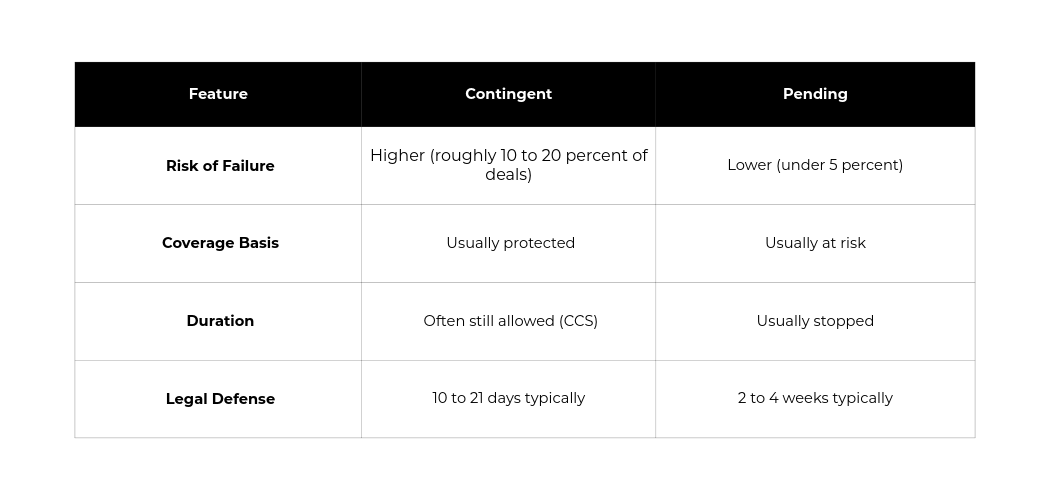
Visibility on the major listing portals
One confusing aspect for Washington buyers is that consumer sites often use their own terminology. Zillow, for example, might label a contingent home as "active under contract," while the NWMLS uses specific codes like "active-contingent." Regardless of the platform, if you see the word "pending," the ship has likely sailed. If you see "contingent," there's still a glimmer of hope.
Specific Washington State contingencies to know
Our state has a unique legal landscape that dictates how these statuses play out. These are the conditions that keep a home in contingent status until they're cleared.
The financing contingency: the most common hurdle
This gives the buyer a window to secure their mortgage and reach loan approval. Even with a pre-approval, a buyer's loan can fail if they lose a job or if rates spike suddenly. In Washington, the financing contingency usually lasts about 21 days. If the buyer can't get to loan approval, the status reverts from contingent back to active.
The inspection contingency: navigating WA's structural requirements
Washington is known for its Form 35, the inspection addendum. Buyers usually have around 10 days, when a professional crawls through the attic and crawlspace to make sure the home isn't hiding structural secrets. In our region's rainy climate, drainage issues or roof moss often become the focal point of these negotiations, and in the Puget Sound area, where many homes are older, this is the stage where most deals are renegotiated.
The appraisal contingency: protecting the buyer's loan
An appraisal contingency lets the buyer back out, or renegotiate, if the home appraisal comes in below the agreed price. Because lenders only finance up to the appraised value, a low number can stall an otherwise healthy deal. If you're a seller, knowing what your home is actually worth before you list helps you price it where it will appraise. Say the appraiser sets the appraised value at 750,000 but the buyer offered 800,000. If the buyer can't cover that gap in cash and the seller won't budge on price, the deal can collapse. In hot pockets of King and Snohomish counties, some buyers waive this protection to win, then scramble if the appraisal falls short.
The title contingency: ensuring a clean transfer
This ensures there are no hidden liens or ownership disputes. In Washington, title companies provide a "preliminary commitment." If a surprise easement or a tax lien pops up, the buyer can walk.
The home sale contingency: a rarity in hot markets like Seattle
This happens when a buyer says, "I'll buy your house if I can sell mine first." In a hot market like Seattle or Spokane, sellers almost never accept a home sale contingency. It's considered too risky, since it makes the sale dependent on a third party's house selling.
A quick word on distressed listings
Not every contingent or pending home is a standard sale. You may run across a "contingent short sale," where the seller owes more than the home is worth and the lender has to approve the deal, or a "pending short sale," where that lender approval is in progress. These move slowly because a bank, not just the seller, calls the shots. A nearby foreclosure can also drag down the comps an appraiser relies on.
Strategies for buyers: how to handle each status
If you find a home you love that's already spoken for, don't lose heart, but do be strategic. Knowing how to make a competitive offer before you tour can be the difference between landing the home and watching it go pending.
The bump clause: how savvy buyers can jump the line
In Washington, if a seller accepts an offer with a home sale contingency, they often include a bump clause (NWMLS Form 35P), a type of kick-out clause. This lets the seller keep marketing the home. If you come along with a better offer and no home to sell, the seller can give the first buyer a 24 to 72 hour notice to either drop their contingency or get bumped out of the way so you can take the spot.
Should you submit a backup offer on a pending home?
It's a long shot, but it costs nothing but a little paperwork, and backup offers win more often than people think. If a pending deal collapses, the seller is often stressed and embarrassed. Having a signed backup offer already in their hand makes you the easy choice, allowing them to skip the "back on market" reset and move straight to you. On a "pending, taking backups" listing, the seller has basically asked for exactly this.
Working with your agent to spot stale pending listings
If a home has been pending for 45 or 60 days, something might be wrong. Standard closing in Washington is around 30 days. Your real estate agent can call the listing agent to ask whether everything is still on track. Sometimes the deal is wobbling, and the seller is quietly looking for an exit strategy.
Strategies for sellers: choosing between the two
As a seller, your goal is to navigate the home selling process and move from "active" to "sold" with as little stress as possible.
The risks of accepting a contingent offer
Every contingency is an escape hatch for the buyer. Accepting a heavily contingent offer means your home is effectively off the market for several weeks while the buyer decides if they actually want it. If they back out, you've lost market momentum, and your home may be perceived as tainted when it returns to active status. This is where leaning on an experienced real estate agent to vet the strength of each accepted offer really pays off.
Protecting your investment during the waiting game
While your home is contingent, keep it show-ready. Don't stop the gardener or let the mail pile up. Every Door's Turnkey Services can handle staging and pre-sale touch-ups so the home shows its best, with nothing paid upfront. You want the home looking its best just in case that primary buyer walks away and you need to attract a new one immediately.
Closing the gap: moving from status to sale
The transition from pending to sold is the most technical part of the journey. If the deal fails along the way, the status on the NWMLS changes to "back on market" (BOM). This is often a "blood in the water" moment for other buyers. You may get lower offers, but you may also find someone who was waiting in the wings for just this opportunity. If everything holds, the escrow company records the deed with the county, whether that's King, Pierce, or Snohomish, and the status officially moves to "sold." That's the moment the keys are handed over and the purchase agreement is legally complete.

Frequently asked questions:
Does "pending" mean the house is sold?
No. It means it's under a firm contract, but the deed has not yet been recorded and the money has not changed hands.
Can a seller back out once a home is pending?
It's very difficult. In Washington, the standard contracts are very buyer-friendly once the contingencies are waived. A seller usually needs a specific legal breach by the buyer to cancel a pending deal.
How long does a home stay in contingent status?
Typically 10 to 21 days, depending on the length of the inspection and financing windows agreed upon in the contract.
Navigating the Washington market with confidence
The jump from contingent to pending is the most stressful part of any real estate transaction. Whether you're a buyer trying to squeeze into a competitive neighborhood or a seller hoping your buyer's loan comes through, understanding these labels lets you manage your expectations. In the Washington market, knowledge is more than just power. It's the difference between a "sold" sign and a "back on market" headache. Keep your eyes on the status, and keep your real estate agent's number on speed dial.
Check out this article next