Seattle neighborhoods by area
Seattle is one of the most neighborhood-diverse cities in the country. The city's official boundaries stretch from the Ship Canal in the north to the Boeing Field area in the south, and from Puget Sound in the west to Lake Washington in the east. Within those boundaries sit more than 50 recognized neighborhoods, each with its own real estate market, buyer profile, and community identity. Here's how the Seattle neighborhood map breaks down, organized by geographic area.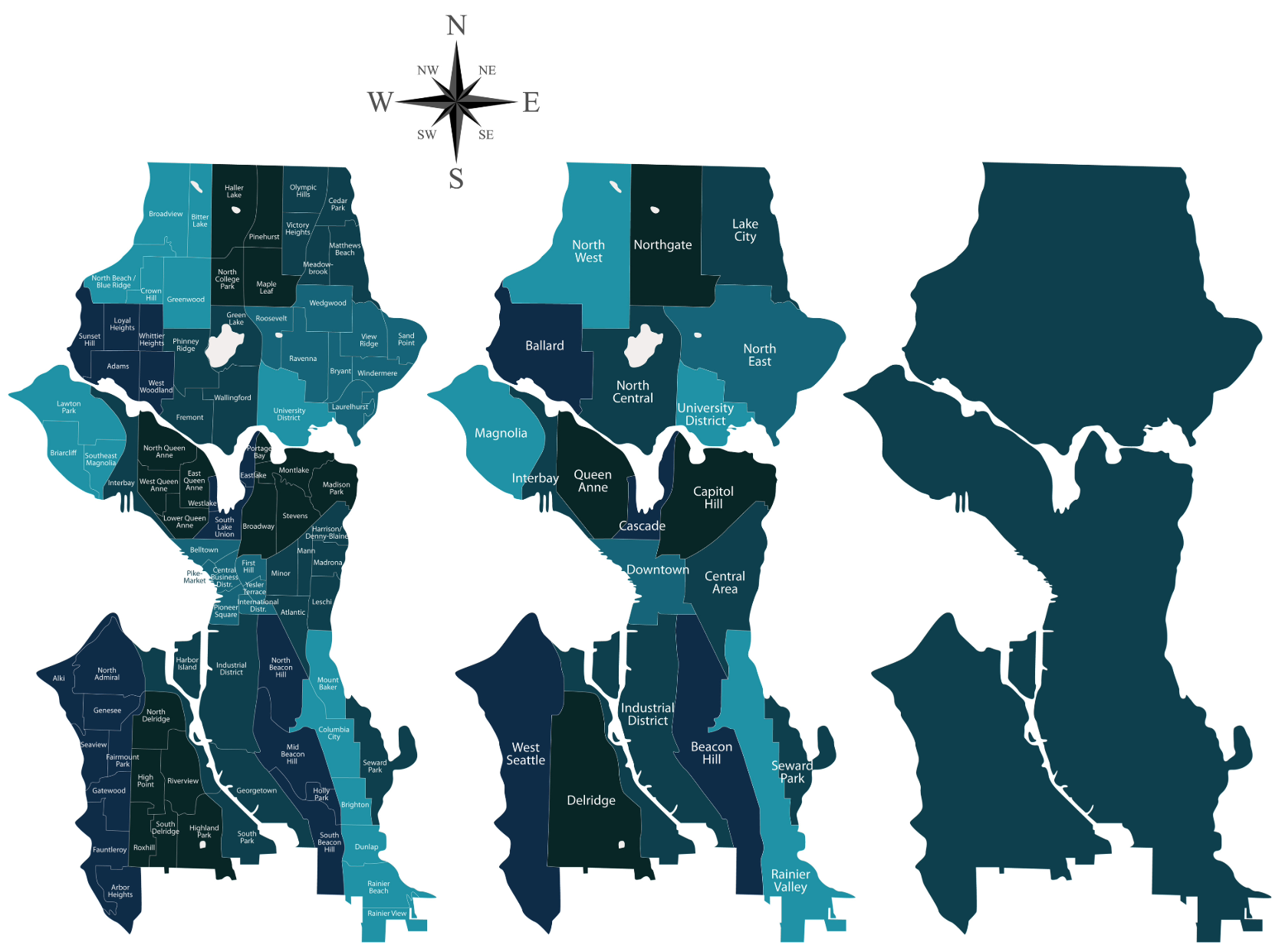
North Seattle
North Seattle runs from the Ship Canal up to the city limits near Shoreline. It's a mix of single-family neighborhoods, transit-served corridors, and green spaces, and tends to offer more square footage per dollar than neighborhoods closer to downtown.
Ballard is the anchor of northwest Seattle, a formerly Scandinavian fishing community now defined by its restaurant scene, brewery culture, and strong demand for single-family homes and townhomes. Neighboring Loyal Heights, Whittier Heights, and Sunset Hill offer slightly quieter residential character with easy access to Ballard's amenities.
Phinney Ridge runs along a north-south ridge between Greenwood and Green Lake and is known for walkable blocks, Craftsman homes, and a tight-knit community feel. Greenwood sits just to the west and is a favorite for first-time buyers looking for more approachable price points with good transit access.
Green Lake surrounds one of Seattle's most beloved parks and draws buyers who want walkability, outdoor recreation, and a neighborhood feel close to the urban core. Adjacent Fremont, famously quirky and increasingly expensive, offers easy access to South Lake Union employers and a lively retail corridor.
Wallingford is a consistently desirable neighborhood of tree-lined streets and classic Seattle homes between Green Lake and the ship canal. Maple Leaf and Roosevelt sit further north and have benefited from Light Rail connections that put downtown within a 15-minute ride.
Further north, Ravenna, Bryant, Wedgwood, and View Ridge form a cluster of family-oriented neighborhoods with strong schools, large lots, and a quieter pace. Hawthorne Hills, Sand Point, and Windermere line the western shore of Lake Washington and offer some of the highest-end single-family homes in northeast Seattle.
Laurelhurst is one of Seattle's most prestigious neighborhoods, with large homes, a private beach club, and proximity to the University of Washington. Matthews Beach and Meadowbrook sit just to the north and offer more accessible price points along the Lake Washington waterfront corridor.
The northernmost tier of Seattle includes Blue Ridge, North Beach, Broadview, Crown Hill, Bitter Lake, Haller Lake, Licton Springs, Olympic Hills, Olympic Manor, Pinehurst, Victory Heights, and Cedar Park. These neighborhoods are quieter, more suburban in feel, and tend to attract buyers looking for more space at lower price points than comparable neighborhoods further south.
Queen Anne and Magnolia
Queen Anne divides into Upper and Lower halves. Upper Queen Anne is residential and elevated, with views of the Olympics and downtown, while Lower Queen Anne sits at the base of the hill near Seattle Center and is denser and more walkable. Both are consistently competitive markets.
Magnolia juts into Puget Sound as a residential peninsula west of Queen Anne, with a neighborhood-within-a-city feel, Discovery Park as its western edge, and a quiet village commercial district. Interbay connects Magnolia to Ballard along the ship canal corridor and has seen growing townhome development as buyers seek more accessible entry points into this part of the city.
Capitol Hill, First Hill, and central Seattle
Capitol Hill is Seattle's most densely populated neighborhood and one of its most energetic. Strong walkability, an active restaurant and arts scene, and excellent transit access make it consistently competitive. Buyers here tend to be younger professionals and investors targeting condos and smaller homes.
First Hill sits between Capitol Hill and downtown and is anchored by major hospitals and medical employers. Eastlake runs along the western shore of Lake Union and draws buyers who want water views and proximity to South Lake Union without Capitol Hill's density. Portage Bay is a small, waterfront-adjacent neighborhood between Eastlake and the University District. Montlake is one of Seattle's most architecturally rich neighborhoods, with Tudor and Craftsman homes on quiet streets close to the Arboretum and UW.
Madison Park, Madison Valley, Madrona, Leschi, and Denny Blaine stretch along the western shore of Lake Washington south of Montlake. These are among Seattle's most desirable and expensive neighborhoods, combining waterfront access, tree-lined streets, and proximity to downtown. Mount Baker continues the lakefront corridor further south with a mix of grand early-20th-century homes and newer construction. Broadmoor is a gated community on the western edge of Madison Park, home to some of Seattle's most expensive single-family properties.
University District and northeast Seattle
The University District surrounds the University of Washington campus and Light Rail station and offers strong rental demand alongside owner-occupied options. The neighborhood is in active transition as transit-oriented development reshapes the blocks around the station.
Downtown, Belltown, and South Lake Union
Downtown Seattle is primarily a condo and rental market anchored by office towers, retail, and hospitality. Belltown sits just north of downtown and is dense, walkable, and active, with strong condo inventory. South Lake Union has transformed rapidly over the past decade into a tech campus hub, with Amazon's headquarters anchoring the neighborhood, and residential demand here reflects proximity to those employers.
Westlake sits between South Lake Union and the Fremont Bridge and is a smaller, transitional neighborhood with growing residential development.
Pioneer Square is Seattle's oldest neighborhood, with historic brick buildings, an active arts community, and easy access to sports venues. The International District borders Pioneer Square to the east and is a cultural hub with strong community roots. The Industrial District sits south of both and is primarily commercial, though residential interest is growing at its edges.
Central District and South Seattle
The Central District is one of Seattle's most historically significant neighborhoods and has seen strong appreciation as buyers seek proximity to Capitol Hill and downtown at more accessible price points. Atlantic is a small neighborhood at the CD's western edge near I-90.
Columbia City, Beacon Hill, Seward Park, and Rainier Beach form South Seattle's primary residential corridor, served by Light Rail and offering some of the best value in the city for buyers priced out of the north end. Brighton, Riverview, and Roxhill sit further inland and west, offering quieter residential character.
Georgetown and South Park are industrial-adjacent neighborhoods in the far south of the city with a growing creative community and among the lowest entry prices for single-family homes within Seattle city limits.
West Seattle
West Seattle sits across the Duwamish River from the rest of the city and has a distinct peninsula character. Residents describe it as a small town inside a major city.
Admiral is West Seattle's commercial and community hub, with a walkable junction area and a mix of single-family homes and condos. Alki runs along the waterfront and draws buyers who want beach access and views of Puget Sound and the Olympics. Fauntleroy anchors the southern tip of the peninsula near the ferry terminal.
Arbor Heights, High Point, Highland Park, Westwood, North Delridge, and South Delridge make up the inland portions of West Seattle and offer more affordable single-family options for buyers willing to trade some walkability for space and price.
Browse current listings for the full West Seattle peninsula.
The Eastside: Bellevue, Kirkland, Redmond, and beyond
East of Lake Washington sits a collection of cities that together function as a second urban center in the Seattle metro area. The Eastside is anchored by tech employers and top-rated schools, and home prices reflect that premium.
Bellevue is the Eastside's largest city and operates as a full urban center in its own right, with its own downtown skyline, corporate headquarters, and high-rise condo market. Redmond is home to Microsoft's campus and draws strong buyer demand from tech professionals. Kirkland offers waterfront access on Lake Washington with a vibrant downtown and one of the most competitive real estate markets on the Eastside.
Issaquah sits at the base of the Issaquah Alps and blends outdoor recreation access with strong schools and family-friendly neighborhoods. Sammamish is a plateau community east of Bellevue and Redmond, known for newer construction, excellent schools, and strong long-term appreciation. Woodinville is the Eastside's wine country hub, with rural character alongside suburban residential neighborhoods.
For ultra-premium waterfront properties, Medina, Clyde Hill, Hunts Point, and Beaux Arts Village are small lakefront communities on the western edge of the Eastside, among the most expensive addresses in Washington State. Mercer Island sits in the middle of Lake Washington, connected to both Seattle and Bellevue by I-90, and offers a self-contained community with excellent schools and strong island identity.
Newcastle sits on the ridge south of Bellevue and offers Eastside schools at slightly more accessible prices. Kenmore and Lake Forest Park sit on the northern shore of Lake Washington and offer waterfront access with a quieter residential feel than Kirkland. Bothell straddles the King-Snohomish county line and has become one of the more underrated growth markets in the region for buyers seeking Eastside-adjacent living at lower price points.
South King County
South King County stretches from Renton to the Pierce County line and includes some of the most diverse communities in the metro area. These neighborhoods tend to offer more square footage and land for the price, making them popular destinations for first-time buyers and families.
Renton anchors the south end of Lake Washington and has seen strong appreciation as buyers discover its combination of proximity to Bellevue and Seattle, strong job base, and more approachable home prices. Tukwila and SeaTac surround the airport and offer excellent transit access at the lowest price points in close-in King County.
Burien and Normandy Park sit on the plateau south of West Seattle, with Burien's established commercial district and Normandy Park's quieter residential character both appealing to buyers priced out of Seattle proper. Des Moines offers waterfront access on Puget Sound and a marina community at a fraction of the cost of comparable Seattle waterfront.
Kent is South King County's largest city, with a strong industrial and logistics employment base and a wide range of housing options. Auburn sits further south along the Green River Valley and combines affordable single-family homes with convenient freeway access. Federal Way is a large suburban city with significant retail and employment anchors and some of the most affordable homeownership opportunities in King County.
Covington and Maple Valley are growing suburban communities in the foothills southeast of Renton, popular with families seeking newer construction and larger lots. Black Diamond is a small historic coal town further south that has seen significant new development in recent years. Enumclaw sits at the base of Mount Rainier's foothills and offers a rural-residential lifestyle within commuting distance of the metro area.
Algona, Pacific, and Milton are small cities along the Auburn-Puyallup corridor that offer entry-level homeownership options with easy freeway access to both King and Pierce County employment centers.
Shoreline and the I-5 corridor north of Seattle
North of Seattle along the I-5 corridor sits a band of communities that have grown significantly in appeal as Light Rail expands northward and Seattle prices push buyers outward.
Shoreline is directly north of Seattle and has become one of the region's most watched real estate markets as Link Light Rail has connected it to downtown Seattle in under 20 minutes. Mountlake Terrace sits just north of Shoreline with its own Light Rail station and offers similar transit advantages at competitive price points. Brier is a small, quiet residential community between Mountlake Terrace and Lynnwood.
Snohomish County: Everett, Edmonds, and beyond
Snohomish County stretches from the I-5 corridor east into the Cascades and north toward Skagit County, encompassing everything from dense transit-connected suburbs to rural mountain towns.
Lynnwood is the transit gateway into Snohomish County, with a major Light Rail station and significant mixed-use development underway around the station area. Edmonds offers waterfront living on Puget Sound with a charming downtown, ferry access to Kingston, and strong community character. Mukilteo sits on the Sound south of Everett with ferry service to Whidbey Island and a strong residential market anchored by Boeing employment. Woodway is a small, exclusive residential community adjacent to Edmonds.
Everett is Snohomish County's largest city and county seat, with a major Boeing manufacturing presence, a growing waterfront district, and some of the most affordable home prices within commuting distance of Seattle. Marysville and Arlington are fast-growing communities north of Everett with newer construction and growing commercial amenities. Stanwood is a small community further north with rural character and Puget Sound waterfront access nearby.
Mill Creek is a planned community south of Everett known for excellent schools, newer homes, and a strong sense of community. Lake Stevens has seen strong growth driven by affordability and lakefront recreation, while Snohomish retains its small-town historic character in the valley east of Everett.
Monroe anchors the Highway 2 corridor heading east toward the Cascades. Further east, Sultan, Gold Bar, and Skykomish are small communities along the US-2 corridor suited to buyers seeking a rural or recreational lifestyle. Granite Falls sits in the foothills east of Marysville and offers affordable rural residential options.
Carnation and Duvall sit in the Snoqualmie Valley and appeal to buyers who want a rural feel without sacrificing access to Eastside employment. North Bend sits at the foot of the Cascades at the I-90 gateway and has seen significant growth as remote work has made its location more practical for commuters.
Pierce County: Tacoma, Gig Harbor, and the South Sound
Pierce County sits south of King County and encompasses Tacoma, the South Sound's largest city, along with a collection of communities that span waterfront suburbs to rural towns.
Tacoma is the South Sound's cultural and economic anchor, with a revitalized downtown, strong arts scene, and significantly lower home prices than Seattle or Bellevue. Many buyers discover that Tacoma offers urban amenities at a fraction of the Seattle cost. Puyallup is a large suburban city in the valley east of Tacoma with strong schools and a mix of established and new neighborhoods. Lakewood and University Place sit southwest of Tacoma along the Puget Sound waterfront and offer established residential neighborhoods with military and civilian employment anchors nearby.
Sumner is a growing community on the highway corridor between Auburn and Puyallup with good freeway access and a mix of residential styles. Gig Harbor sits across the Narrows Bridge from Tacoma and has become one of the most desirable communities in the South Sound, with a charming harbor village, waterfront properties, and strong appeal for buyers seeking a slower pace with easy access to Tacoma and beyond.
The Kitsap Peninsula: Bremerton, Poulsbo, and the ferry communities
The Kitsap Peninsula sits across Puget Sound from Seattle, accessible by ferry and the Narrows Bridge. For buyers willing to commute by water, the Kitsap communities offer a dramatically different lifestyle at significantly lower price points than the mainland.
Bremerton is the peninsula's largest city and the primary ferry hub to Seattle, with a revitalizing downtown and some of the most affordable waterfront-adjacent properties in the Puget Sound region. Silverdale is Kitsap's commercial hub, a growing suburban community with strong retail and healthcare employment. Port Orchard offers waterfront character across the bay from Bremerton at accessible price points. Poulsbo is a Scandinavian-heritage community on Liberty Bay with a walkable downtown and strong community identity, popular with buyers seeking a small-town feel. Olalla is a small unincorporated community in South Kitsap with rural character and Sound views.
Frequently asked questions about Seattle neighborhoods
What are the most popular neighborhoods in Seattle? Ballard, Capitol Hill, Queen Anne, Wallingford, and Fremont are consistently among the most in-demand neighborhoods for buyers who prioritize walkability and proximity to downtown. For families, Laurelhurst, Wedgwood, View Ridge, and Ravenna tend to rank at the top. West Seattle has grown significantly in popularity as Light Rail expansion approaches.
Which Seattle neighborhoods are most affordable? South Seattle neighborhoods including Rainier Beach, Beacon Hill, Columbia City, and Georgetown offer the most accessible price points within Seattle city limits. Just outside the city, Shoreline, Burien, Renton, and South King County cities like Kent and Auburn provide more options for buyers priced out of Seattle proper.
What is the difference between the Eastside and Seattle? The Eastside refers to the cities east of Lake Washington, including Bellevue, Redmond, Kirkland, and Issaquah. These cities are separate municipalities with their own downtown areas, school districts, and real estate markets. The Eastside generally has higher median home prices than most Seattle neighborhoods and is strongly influenced by tech sector employment.
What neighborhoods are good for families in Seattle? Families consistently favor Northeast Seattle neighborhoods like Laurelhurst, Wedgwood, View Ridge, Bryant, and Ravenna for their strong schools and large lots. On the Eastside, Bellevue, Redmond, Sammamish, and Issaquah are among the most family-oriented markets in the region.
Which Seattle area neighborhoods have the best access to transit? Neighborhoods along the Link Light Rail spine have the strongest transit access: Capitol Hill, University District, Roosevelt, Northgate, and the Rainier Valley corridor within Seattle. Just outside the city, Shoreline, Mountlake Terrace, and Lynnwood have Light Rail stations with direct service to downtown Seattle.
Finding your neighborhood with Every Door Real Estate
No matter where you land on this Seattle neighborhood map, the fundamentals of the Puget Sound real estate market apply broadly: inventory is constrained, demand is durable, and local knowledge matters more than market timing.
Whether you're drawn to a walkable Seattle neighborhood, a family-focused Eastside suburb, an affordable South Sound community, or a quiet Kitsap waterfront, Every Door Real Estate works with buyers and sellers across the entire region. Our real estate agents know these markets at the street level and can help you build a strategy that fits your timeline, budget, and lifestyle.
Browse homes across all communities or reach out to talk through which neighborhoods belong on your short list.
Check out this article next