
Closing costs in Washington State typically run about 2 to 3 percent of the purchase price for buyers and often more than that for sellers, once agent compensation and the state excise tax are counted. They are the fees, taxes, and administrative charges required to actually transfer ownership of a home, and they come due at the end of the transaction when most people have already spent their attention on the down payment.
On a $600,000 home, a buyer is generally looking at somewhere in the range of $12,000 to $18,000. A seller on a $700,000 home can see a materially larger number, driven mostly by the real estate excise tax and whatever agent compensation was negotiated.
This guide breaks down every line item on both sides, explains who customarily pays what in Washington, and covers the levers that actually reduce the total.
What are closing costs?
Closing costs are the collection of charges due at the end of a real estate transaction, separate from the price of the home itself. They generally fall into five buckets:
- Loan costs. Origination fees, underwriting, credit report, and the appraisal.
- Title and escrow. Title insurance, the title search, and the escrow company's fee for holding funds and coordinating the closing.
- Government charges. Recording fees and, in Washington, the real estate excise tax.
- Prepaid items. Property taxes and homeowners insurance, typically prorated and collected in advance.
- Professional services. Agent compensation, home inspection, and any attorney fees.
The exact mix depends on the loan amount, the county, and which side of the table you are sitting on.
Who pays closing costs in Washington State?
Washington is a shared-cost state. Neither party pays everything, and the split follows local custom more than any statute.
Buyers customarily pay: lender and loan-related fees, lender's title insurance, the home inspection, prepaid property taxes and homeowners insurance, and roughly half the escrow fee.
Sellers customarily pay: the real estate excise tax, owner's title insurance protecting the buyer, roughly half the escrow fee, and any agent compensation they have agreed to.
Custom is not law. Nearly every one of these is negotiable, and in a softer market, buyers often ask for seller concessions to cover part of their costs. That request is written into the offer and shows up as a credit at closing.
Average closing costs in Washington State
Statewide, combined closing costs for both parties tend to land somewhere in the 2 to 5 percent range of the purchase price, though the seller side climbs well past that once agent compensation is included.
Here is how the two sides usually compare on a $700,000 home:
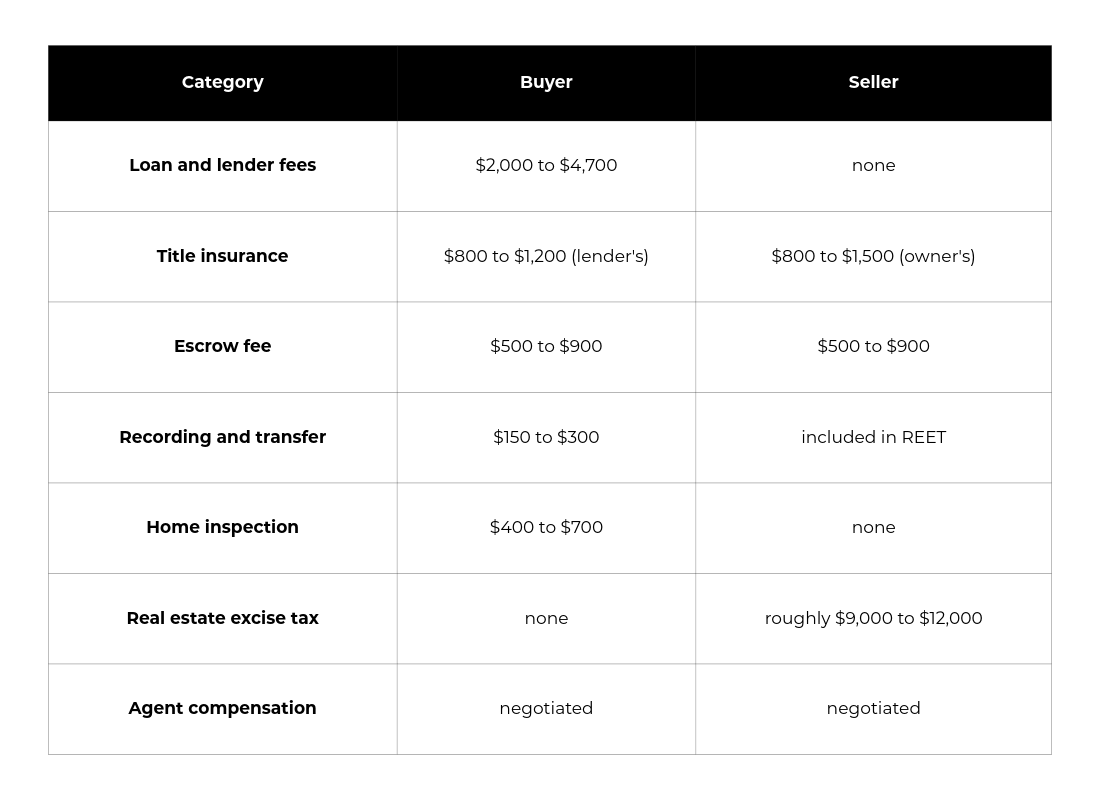
The two numbers that move the most are the excise tax, which is fixed by statute, and agent compensation, which is not fixed by anything.
Buyer closing costs: the full breakdown
Loan-related fees
Your lender sets these, and they vary more between lenders than most home buyers expect.
- Loan origination fee: typically 0.5 to 1 percent of the loan amount
- Underwriting or processing: $300 to $600
- Credit report: around $50
- Home appraisal: usually $500 to $800
Because the origination fee scales with the loan, this is where comparison shopping pays off. Two lenders quoting a similar interest rate can still be several thousand dollars apart on fees.
Title and escrow fees
The title company confirms that the seller actually owns what they are selling and that no old liens are attached. Escrow holds the money and coordinates the paperwork.
- Lender's title insurance: $800 to $1,200, protects the mortgage lender
- Escrow fees: $500 to $900, usually split with the seller
- Title search and recording fees: $150 to $300
Prepaid and recurring costs
- Property taxes: prorated to the closing day based on assessed value
- Homeowners insurance: $1,200 to $2,000 annually, with the first year often paid up front
- Private mortgage insurance: generally required on a down payment under 20 percent
- Home inspection: $400 to $700, paid before closing rather than at it
A closing costs calculator will get you in the neighborhood, but your lender's Loan Estimate is the document that actually matters.
Seller closing costs: the full breakdown
Real estate excise tax
This is the line item unique to Washington, and it catches a lot of sellers off guard. The state charges a graduated excise tax on the sale price:
- 1.1 percent on the portion up to $525,000
- 1.28 percent on the portion from $525,000 to $1,525,000
- 2.75 percent on the portion from $1,525,000 to $3,025,000
- 3 percent on the portion above $3,025,000
It is graduated, meaning each rate applies only to the slice of the sale price inside that bracket, not to the whole amount. Most cities and counties also add a local excise tax on top, commonly in the range of 0.25 to 0.50 percent, so the effective combined rate in places like Seattle and King County runs higher than the state figures alone. The Washington State Department of Revenue publishes the current brackets and local rates, and they are worth checking rather than assuming, since the thresholds are periodically adjusted.
Agent compensation
For most sellers this is the largest single cost, and it is worth being precise about how it works now.
Commissions are not set by law, by any board, or by any standard rate. They are negotiated between a seller and their listing agent, and since the 2024 changes to how buyer agent compensation is handled, whether the seller contributes anything toward the buyer's agent is a separate negotiation that happens deal by deal. Rates vary meaningfully by brokerage and by service level.
The practical takeaway is that this number is a conversation, not a given. Ask what you are paying for, ask what is included, and ask what happens if the buyer brings their own agent.
Title, escrow, and everything else
- Owner's title insurance: $800 to $1,500, customarily paid by the seller to protect the buyer
- Escrow fees: $500 to $900, typically split
- Outstanding liens or HOA fees: must be cleared before the deed transfers
- Repairs or repair credits: negotiated after the inspection
- Attorney fees: $400 to $1,000, optional and more common in complex sales
- Courier and notary: $100 to $200
Repair credits deserve a note. A buyer who finds $8,000 of deferred maintenance during inspection will usually ask for a credit larger than the actual cost of the work, because they are pricing in hassle and uncertainty. Sellers who handle known issues before listing tend to keep more of their net proceeds. If you would rather not front the cost of that work, Every Door Real Estate's Turnkey Services covers pre-sale repairs and preparation with costs settled at closing. It is optional, and plenty of sellers do the work themselves.
Common misconceptions about closing costs
"Closing costs are just the down payment." They are entirely separate. A buyer putting 20 percent down on a $600,000 home needs the $120,000 plus another $12,000 to $18,000 on top.
"There's a standard commission rate." There is not, and there never legally was. Anyone describing a rate as standard or typical is describing a habit, not a rule.
"The seller pays the buyer's agent." That was the old default. It is now negotiated separately in each transaction, and buyers should expect to have a conversation about it with their own agent up front.
"You can't shop for title and escrow." In most cases you can choose your own title company. Buyers rarely do, and it leaves money on the table.
"Rolling costs into the loan makes them free." It makes them financed. You will pay interest on them for the life of the mortgage.
How to estimate your closing costs
Start with a rough percentage, then replace it with real documents as they arrive.
- Buyers: budget 2 to 3 percent of the purchase price as a working figure.
- Sellers: calculate the excise tax first, since it is knowable to the dollar, then add negotiated agent compensation and roughly $2,000 to $3,000 for title, escrow, and administrative costs.
- Read the Loan Estimate. Your lender must provide it within three business days of your application. It lists every fee.
- Compare it to the Closing Disclosure. This arrives at least three business days before closing. Line it up against the Loan Estimate and ask about anything that moved.
Those two documents exist specifically so that you can catch surprises before closing day rather than at it.
Strategies to reduce what you pay
If you are buying:
- Compare at least three lenders on total fees, not just the interest rate
- Ask for seller concessions, especially when a home has been sitting
- Choose your own title company rather than defaulting to the one suggested
- Time your closing near the end of the month to reduce prepaid interest
If you are selling:
- Negotiate compensation and understand exactly what services it buys
- Address known repairs before the inspection rather than after
- Understand where your sale price falls in the excise tax brackets, since a home priced just over a threshold pays the higher rate only on the portion above it
- Ask for a net proceeds sheet early, not at signing
For a deeper look at how presentation and pricing affect the seller side of the ledger, our guide to selling a luxury home in Seattle covers the higher excise tax brackets in more detail.
Where a real estate agent fits in
A good agent should hand you a realistic cost estimate early, not the week of closing. On the buy side, that means flagging which lender fees are negotiable and which are not. On the sell side, it means a net proceeds sheet that accounts for the excise tax and any credits before you accept an offer, so the number you agree to is close to the number you take home.
If you want that estimate for your specific situation, the team at Every Door Real Estate can walk through the line items with you. Sellers weighing a move can also start with a free home valuation to see what the excise tax picture looks like at current market value.
Key takeaways
- Buyers in Washington typically pay 2 to 3 percent of the purchase price, mostly in lender, title, and inspection fees.
- Sellers pay the real estate excise tax, which is graduated from 1.1 to 3 percent of the sale price, plus local excise tax on top in most cities.
- Agent compensation is negotiable and is not set by any standard rate.
- Escrow fees are customarily split, but nearly everything in a real estate transaction is negotiable.
- The Loan Estimate and Closing Disclosure are your two best tools for catching unexpected fees before closing day.

Frequently asked questions
Is Washington a buyer-pays or seller-pays state? Neither. Costs are shared. Buyers generally cover loan and lender's title fees, sellers cover the excise tax and owner's title insurance, and escrow is usually split.
Can closing costs be rolled into the mortgage? Often yes, depending on the lender and loan type. It raises your loan amount and the total interest you pay over the life of the loan, so it is a cash flow decision rather than a savings one.
What is the real estate excise tax? A graduated state tax on the sale price of real property, ranging from 1.1 to 3 percent depending on the bracket, paid by the seller at closing. Most cities and counties add a local excise tax as well.
How long does closing take in Washington? Most financed transactions close in 30 to 45 days. A cash purchase can close considerably faster, since there is no appraisal or underwriting in the way.
Editor's note: This article is for educational purposes only. Estimates are based on publicly available data and typical ranges in Washington State. Actual costs vary by lender, loan terms, location, and transaction details, and excise tax brackets are periodically adjusted. This is not legal or tax advice. For questions about your specific situation, consult a qualified professional or contact Every Door Real Estate for a personalized estimate.
Check out this article next