What is the average mortgage payment in Washington State?
The median monthly housing cost for a Washington homeowner with a mortgage is $2,445, according to the U.S. Census Bureau's American Community Survey for 2020 to 2024. The national figure is $1,963. Washington ranks among the ten most expensive states on this measure.
Two things to know about that number. First, the Census figure is "selected monthly owner costs," which includes the mortgage payment plus property taxes, insurance, utilities, and any HOA dues. It is closer to a total housing cost than to a loan payment. Second, it is a median across every mortgaged household in the state, whenever they bought and at whatever rate. Roughly half of Washington homeowners are paying less than $2,445, most of them because they locked a rate below 4% before 2022.
That is the average. It is not the price of admission.
What does a buyer in Washington pay today?
About $3,160 a month in principal and interest on a typical home, and more in every city on the west side of the Cascades.
The typical Washington home is worth $591,879 as of August 2026, per Zillow's home value index, down 0.3% from a year ago. With 20% down, that is a $473,503 loan. At the Freddie Mac average 30-year rate of 7.03% for the week of September 24, 2026, the principal and interest payment is $3,160.
Property tax adds about $440 a month. Washington's statewide average levy rate is $8.96 per $1,000 of assessed value for taxes due in 2025, per the Department of Revenue, which on a $591,879 home is roughly $5,300 a year. Homeowners insurance and any HOA dues come on top of that and vary enough by property that a quote is the only honest number.
So the realistic all-in payment for a median Washington home bought this fall is in the $3,700 to $3,900 range. That is about $1,300 a month more than the Census median, and the gap is the whole story of the current market: the people who own already are fine, and the people trying to get in are paying 50% more for the same house.
Average mortgage payment by city in Washington
The statewide figure hides a range of more than 3 to 1. Principal and interest only, 30-year fixed at 7.03%, on Zillow's typical home value for each city as of August 2026:
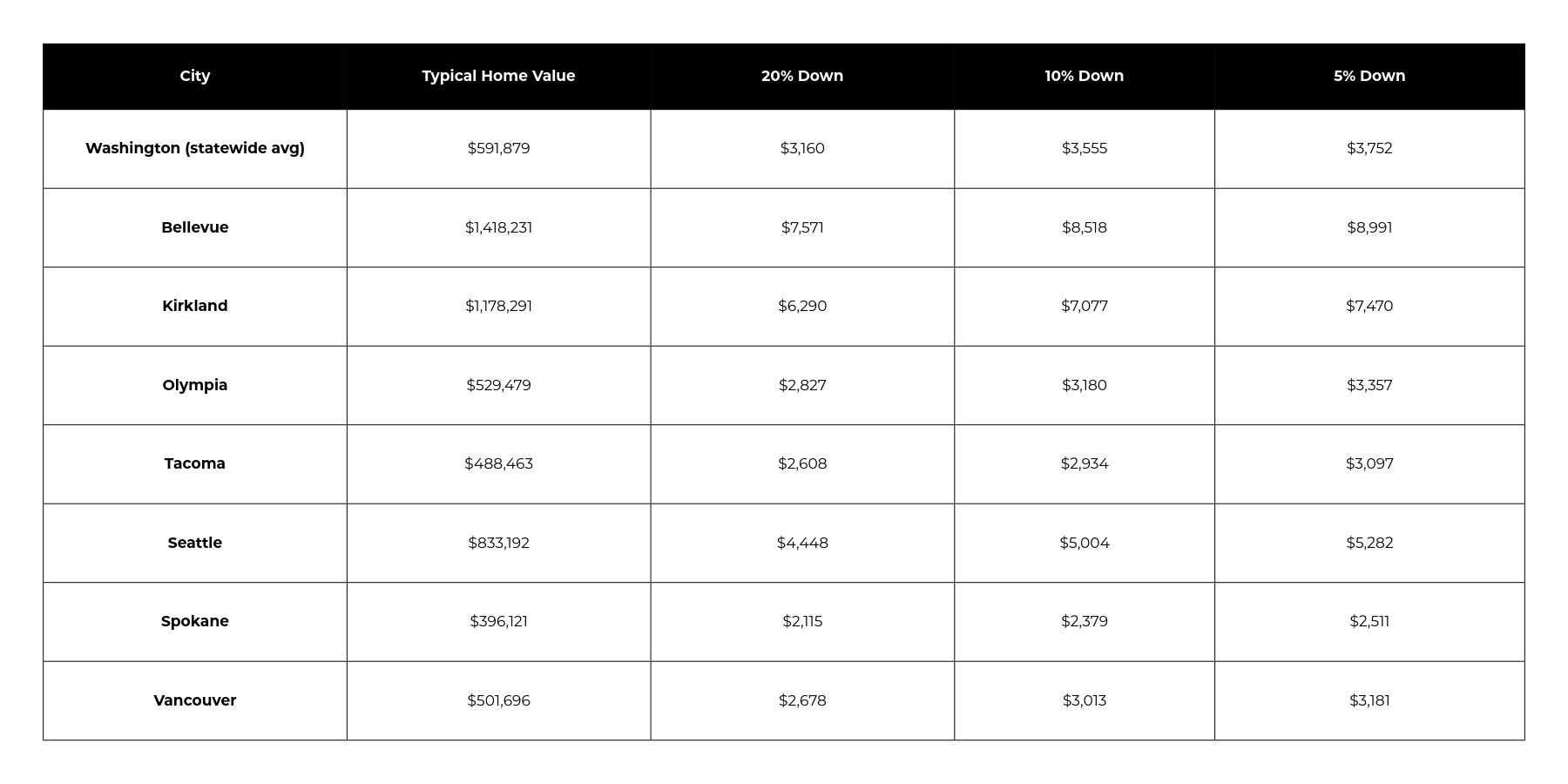
The 10% and 5% columns understate the real payment, because a down payment under 20% on a conventional loan adds private mortgage insurance, and in Kirkland and Bellevue a loan that size is a jumbo loan with its own pricing. Read those columns as the floor.
Two patterns worth noticing. Tacoma, Vancouver, and Olympia cluster within $220 a month of each other and about $1,800 below Seattle, which is the arithmetic behind the commute-for-affordability decision thousands of households make every year. And the Eastside is its own market: a Bellevue buyer with 20% down pays more in principal and interest alone than a Spokane buyer pays for a whole house with 5% down, three times over.
Our Seattle market page, Bellevue market page, Kirkland market page, and Tacoma market page carry the price trends behind each row.
How much does the interest rate change the payment?
More than the price does, at the margin. On the statewide typical home with 20% down:
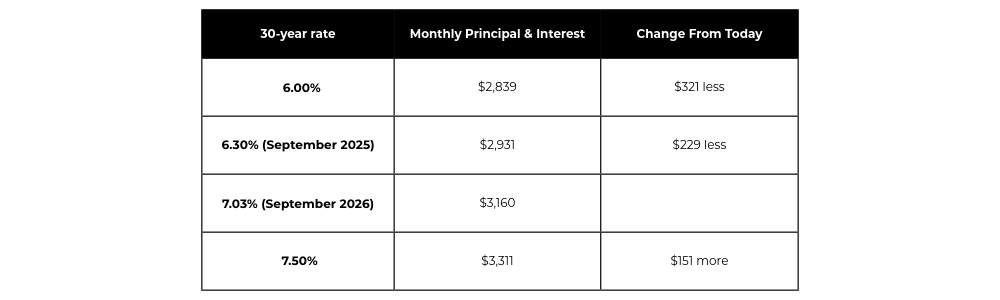
The move from 6.30% to 7.03% over the past year added $229 a month to the same loan, which over 30 years is about $82,000 in additional interest. Put differently: a buyer who needs the payment to stay at $2,931 has to shop about $34,000 cheaper than they could a year ago. That is why Washington home values drifted down while sales volume held; the buyers are still here, and their budgets are smaller.
A 15-year fixed at 6.42% on the same $473,503 loan is $4,104 a month, about $944 more than the 30-year, and it retires the loan 15 years sooner. Few first-time buyers in this market can carry it. Move-up buyers with equity from a prior sale sometimes can.
What goes into a mortgage payment in Washington?
Four pieces, and the ones that are not the loan add 15% to 25% to the total.
Principal and interest. The loan itself. Everything in the tables above.
Property tax. Washington's average is $8.96 per $1,000 of assessed value, about 0.9% a year, though it ranges by county and by the voter-approved levies in each district. King County and the Eastside cities tend to run near or slightly below the state average on rate while paying far more in dollars because the assessed values are higher. Our guide to Washington property tax rates covers how the levy system works. The lender collects this monthly into escrow.
Homeowners insurance. Also escrowed. Washington premiums are moderate compared to wildfire and hurricane states, but a home under big trees, on a slope, or near the water prices differently than one that is not. Get two quotes before you write the offer, not after.
Private mortgage insurance, if under 20% down. PMI on a conventional loan runs until you reach 20% equity. FHA loans carry their own mortgage insurance for the life of the loan in most cases. This is the line that makes a 10% down payment cost more than the table shows.
HOA dues, if any. Condos and many newer subdivisions. Not part of the mortgage, but the lender counts it in your debt ratio and you pay it every month regardless. Our look at the Seattle condo market covers what dues add to a downtown payment.
One thing Washington does not have: a state income tax. A household earning $175,000 keeps several hundred dollars a month more here than in Oregon or California, which is a large part of why lenders can qualify Washington buyers for payments that would strain the same income across the border. Our guide to the cost of living in Seattle puts the mortgage payment next to everything else.
How much income do you need to afford a mortgage in Washington?
Roughly $135,000 a year for the statewide typical home, and about $190,000 for Seattle, using the standard 28% guideline on principal and interest alone.
What is the “28% Rule”?
The 28% rule says housing costs should stay under 28% of gross monthly income. On the $3,160 statewide payment, that implies about $135,400 in annual income. On Seattle's $4,448, about $190,600. Add taxes and insurance and the real thresholds are 10% to 15% higher. Add a car payment and student loans and the lender's back-end ratio, usually capped near 43% to 45% of income for all debts, may bind first.
Those are rules of thumb, not lender decisions. A buyer with no other debt and strong reserves can go past 28%. A buyer with $900 in car payments cannot reach it. Our guide to buying a house in Washington State covers the full cost picture, and how to save for a house in Washington covers getting to the down payment.
How can you lower your mortgage payment?
Four levers, in order of how much they move the number.
Buy down the rate with a seller credit. In a market where 37% of Kirkland listings have cut their price, sellers are open to credits. A credit applied to discount points or a temporary buydown lowers the payment every month instead of once at closing. Our guide to seller credits covers the limits by loan type.
Put more down, but only to the 20% line. Every $10,000 more down saves about $67 a month at 7.03%. Crossing from 19% to 20% also removes PMI, which is worth far more than the $67. Past 20%, the return on extra down payment drops, and the cash may be better kept as reserves.
Use a program if you qualify. Washington's Home Advantage program and local down payment assistance reduce cash to close and, in some structures, the payment. Our guides to down payment assistance in Washington and first-time homebuyer programs cover eligibility.
Shop the rate. Two lenders quoting the same day routinely differ by an eighth to a quarter point. On a $473,503 loan a quarter point is about $80 a month for 30 years. It is the highest-return hour of the whole purchase.
What to know if you are buying
Run the payment, not the price. A $600,000 house is a $3,160 payment or a $3,752 payment depending on your down payment, before PMI, and the difference decides what you can actually carry.
Get the full payment from your lender in writing before you tour. Principal, interest, tax estimate, insurance estimate, PMI if applicable. Then look at homes whose all-in payment you can hold if your income does not grow for three years.
Compare cities on payment, not just price. The table above is the comparison. An $1,800-a-month gap between Seattle and Tacoma pays for a lot of driving, or it is the difference between buying and waiting.
Ask about a buydown before you ask about a price cut. A seller who will not come down $20,000 will sometimes pay $20,000 in credits, and the credit lowers your payment more than the price cut would. Our guide to renting vs buying in Seattle covers when the payment makes sense against rent.
Know how the financing contingency protects you. If the rate moves against you between offer and lock and the payment no longer qualifies, the financing contingency is what returns your earnest money. Washington's version has no rate cap, so lock early.
What to know if you are selling
Your buyer's payment is what you are negotiating against, whether or not anyone says so.
Price to the payment your buyer can carry. At 7.03%, every $10,000 on your list price is about $53 a month to a 20%-down buyer. Buyers are running that math on every listing. A price that pencils to a round monthly number draws more offers than one that does not.
Offer a rate buydown instead of a price cut. A $15,000 credit toward points lowers a buyer's payment more than a $15,000 price reduction and keeps your recorded sale price higher, which matters for the comparable sales on your street. Our cost to sell a house in Washington guide shows where a credit sits among your other costs.
Expect the appraisal to matter more. Higher rates mean buyers are stretching, and a low appraisal on a stretched buyer is a renegotiation. Price to the last 90 days of closed sales, not to the spring.

Frequently asked questions
What is the average mortgage amount in Washington State?
The Census Bureau puts the median owner-occupied home value in Washington at $564,600 for 2020 to 2024. A buyer today financing 80% of Zillow's typical value of $591,879 borrows about $473,500. Both are medians across the state; a typical King County loan is well above them and a typical Spokane loan well below.
Is $3,000 a month a good mortgage payment in Washington?
It is below what a buyer pays for the statewide typical home today ($3,160 in principal and interest with 20% down) and well below the Seattle figure. In Tacoma, Vancouver, Olympia, or Spokane, $3,000 buys a typical home with 10% down. Whether it is good for you depends on income: under the 28% guideline, $3,000 a month implies about $128,600 a year before taxes and insurance.
Does the average mortgage payment include property taxes and insurance?
The Census figure of $2,445 does; it includes taxes, insurance, utilities, and HOA dues. The payment tables in this article show principal and interest only, so that the rate and price effects are visible. Add about 0.9% of the home's value per year for Washington property tax, plus an insurance quote, to get an all-in figure.
How much is a mortgage payment on a $600,000 house in Washington?
With 20% down at 7.03%, about $3,203 a month in principal and interest on the $480,000 loan. With 10% down, about $3,604 plus PMI. Property tax at the state average adds about $450 a month.
Reading the payment before you read the price
Washington's average mortgage payment describes people who already own. The payment that matters to a buyer this fall is about $1,300 a month higher, and the rate is doing most of that work. Knowing both numbers, and the gap between cities, is the difference between shopping for a house and shopping for a payment you can keep.
At Every Door Real Estate, we help buyers run the real all-in number before they fall for a listing, and we help sellers price and structure offers around what today's buyer can carry. If you are working out what you can afford in Washington this year, talk with our team.
Payment figures are computed from published averages and are estimates for comparison. Your rate, tax bill, insurance premium, and mortgage insurance depend on your credit, property, and lender. Confirm your actual payment with a lender before making an offer.
Check out this article next