
How long does it take to close on a house in Washington?
About 30 to 45 days for a buyer with a mortgage, and 7 to 14 days for a cash buyer. The clock runs from mutual acceptance to the day the county records the deed.
The closing date is written into the purchase agreement, NWMLS Form 21, at the offer stage. Most Washington agents write 30 to 45 days for a financed home purchase. That is how long a mortgage lender needs to order an appraisal, underwrite the file, and clear the federal disclosure waiting period. A cash purchase skips the mortgage lender and is limited only by title work and escrow scheduling. Our 14-step guide to buying a house in Washington covers the whole process; this page is the clock.
What happens in each week of a Washington closing?
The timeline below assumes a 45-day financed purchase. A 30-day close compresses the middle, not the ends.
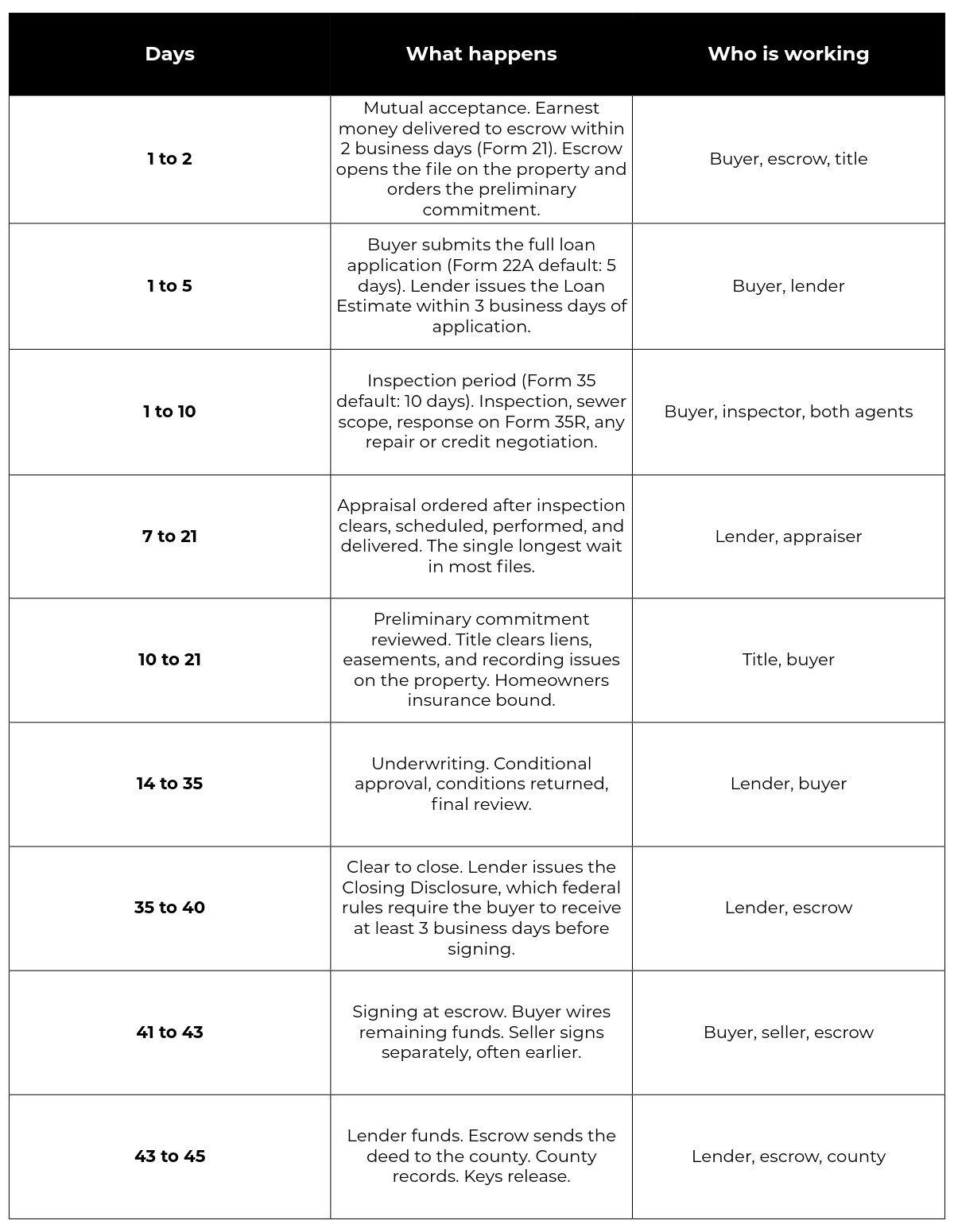
The weeks are not equal. Days 1 to 10 are busy for the buyer. Days 14 to 35 are busy for the lender and feel quiet to everyone else. That is when buyers start calling their agent to ask what is wrong. Nothing is wrong; underwriting is slow by design.
Why does Washington close at recording instead of a closing table?
Because Washington uses an escrow closing model. A neutral third party collects every signature and every dollar, then transfers ownership of the property by recording the deed with the county.
In a closing-table state, the buyer, seller, lender's documents, and attorney meet in one room. Everything is signed and funded at once, and keys change hands before anyone stands up. In Washington the escrow officer collects the seller's signed deed on one day, the buyer's signed loan documents on another, and the lender's wire on a third. Only then does escrow submit the deed to the county auditor.
Ownership transfers at the moment of recording. That is closing. Our guide to when you get keys after closing in Washington covers those last three days in detail, including what happens when funding misses the county's recording cutoff.
The practical effect for a buyer is that "closing day" on the contract is the recording day, and the signing appointment is a few days before it. Movers, utilities, and time off work get planned around the recording date.
What slows a Washington closing down?
Three things account for most delays, and the buyer controls two of them.
Paperwork returned late. Underwriters ask for financial paperwork in rounds: a bank statement, a letter explaining a deposit, an updated pay stub. Every day a condition sits in your inbox is a day added to the file. Buyers who answer the same day close on time. Buyers who answer on Friday close the following week.
A slow appraisal. The lender cannot order it until the inspection contingency is resolved, and in a busy month the appraiser's calendar is two weeks out. If the appraisal comes in low, Form 22A's low-appraisal provisions start a negotiation that adds another week. Our guide to appraisal gaps in Washington covers that scenario.
A change in the buyer's file. A new car loan, a job change, a large unexplained deposit, or a credit score that moved. Any of these can send the file back to underwriting. The rule from application to recording is simple: change nothing.
Two Washington-specific delays sit behind those three. A title issue on the preliminary commitment, such as an unreleased lien from a prior owner's refinance, can take weeks to clear. That is why the preliminary title report gets read in week two, not week six. And a seller still finishing their own home purchase can push the date. In that case the contract's closing date is renegotiated by addendum rather than slipping on its own.
Can you close in less than 30 days in Washington?
Yes, with cash or with a fully underwritten buyer, and sellers pay attention to offers that promise it.
A cash purchase routinely closes in 7 to 14 days. The only waits are the preliminary commitment, the inspection period if the buyer keeps one, and escrow's calendar. A financed purchase can close in 21 to 25 days under three conditions. The buyer walks in with a fully underwritten pre-approval, the appraisal is ordered the day of mutual acceptance, and the buyer shortens the inspection period.
Below 21 days with a mortgage loan is rare. The federal 3-business-day Closing Disclosure rule, the appraisal, and the lender's own processing floor make it hard regardless of how organized the buyer is. A seller who needs a fast close is better served by a cash offer than by a financed buyer promising 14 days. Our comparison of cash offers vs financed offers covers how to weigh the two.
What happens on signing day, funding day, and recording day?
Three days, three events, and only the last one makes the home yours.
Signing day. You meet the escrow officer, usually at the escrow company's office or with a mobile notary, for about an hour. You sign the promissory note, the deed of trust, and the settlement statement. You wire the balance of your down payment and closing costs, which the Closing Disclosure itemized three days earlier. The seller signs the deed and their settlement documents, often a day or two before you. Nothing transfers yet.
Funding day. The lender reviews the signed package and wires the loan proceeds to escrow. This can be the same day as signing or the next business day. Escrow confirms every dollar has arrived.
Recording day. Escrow submits the deed to the county auditor. The county records it, usually within hours, and the home is legally yours. Escrow releases the keys, typically through your agent, the same afternoon. If funding arrives after the county's recording cutoff, recording slips to the next business day, and so do the keys.
What to know if you are buying
Plan the move around the recording date, and spend the quiet weeks doing the lender's work before they ask.
Answer the lender the day they ask. Conditions are the clock. A buyer who returns every document within 24 hours is the one who closes on the contract date.
Book the inspection the day of mutual acceptance. It unlocks the appraisal order, and the appraisal is the long pole.
Bind homeowners insurance by week two. The lender needs the policy before closing, and a home under big trees or on a slope sometimes takes two quotes.
Expect the Closing Disclosure three business days before signing. Read it against the Loan Estimate from week one. The closing costs should match within tolerances; if a lender fee jumped, ask why before closing.
Change nothing. No new credit, no job changes, no large deposits or withdrawals you cannot document, from application to recording.
What to know if you are selling
Your closing speed depends on the buyer's lender, and the contract gives you tools to protect your timeline.
Read the buyer's financing terms before the price. A fully underwritten buyer with a 25-day close is worth more than a pre-approved buyer at 45. Our financing contingency guide explains what the Form 22A blanks mean for your calendar.
Sign early. Sellers can sign their documents days before the buyer. Doing so removes you from the critical path.
Use the notice to perform if the file stalls. If the buyer has not waived financing and the date is approaching, Form 22AR gets you an answer in 3 days. Our guide to the notice to perform covers when to send it.
Plan your own move around recording, not signing. You should be fully out by the morning of expected recording. A seller still loading a truck when the buyer legally owns the home is a situation nobody enjoys. Our home selling checklist sequences the last two weeks.

Frequently asked questions
Can I close on a house in 2 weeks?
With cash, yes; 7 to 14 days is normal. With a mortgage, almost never. The appraisal, underwriting, and the federal 3-business-day Closing Disclosure waiting period make 21 days the practical floor for a financed purchase, and 30 is far more common.
What does "clear to close" mean?
The lender's underwriter has approved the loan with no remaining conditions, and the file moves to closing. In Washington, clear to close comes about a week before recording. The lender prepares the Closing Disclosure, the buyer waits the 3 business days and signs, the lender funds, and the county records.
Can a sale fall apart on closing day in Washington?
Rarely, and almost always for a reason visible earlier: a last-minute credit pull showing new debt, funds that did not arrive, or a title issue found late. A buyer who changed nothing, wired on time, and read the preliminary commitment in week two does not have a closing-day surprise.
When do I get the keys?
After the county records the deed, usually within hours of recording and typically one to three business days after you sign. Not at signing. The keys-after-closing guide linked above covers the exact sequence and the cutoff times.
Closing on time in Washington
The 30-to-45-day window is a lender's window, and the home buyer who treats the quiet weeks as work weeks closes at the front of it. The seller who reads the financing terms picks the buyer who will.
At Every Door Real Estate, we walk buyers through every deadline from mutual acceptance to recording. We help sellers pick offers that will close on the date they need. If you are heading toward a closing anywhere in Washington, talk with our team.
This article describes the typical Washington closing timeline under NWMLS forms and federal lending rules. The dates in your contract control, and form defaults change with revisions. Confirm the specifics with your agent, lender, and escrow officer.
Check out this article next