
What is a fully underwritten pre-approval?
A fully underwritten pre-approval is a mortgage approval issued by an underwriter, not a loan officer, before you have a house under contract. The underwriter reviews your full file, the same way they would after you sign a purchase agreement. The approval they issue is conditional only on the property: the appraisal, the title, and the purchase contract itself. Everything about you as a borrower is already decided.
A standard pre-approval is different in kind, not degree. A loan officer looks at your credit report, your stated income, and whatever documents you volunteer, and writes a letter saying you are likely to qualify. Nobody with authority to approve the loan has read the file. That letter is what most buyers carry into their first offer, and it is why financed offers lose to cash.
Pre-qualification vs. pre-approval vs. underwritten approval
Three documents, three levels of certainty, and sellers' agents know the difference.
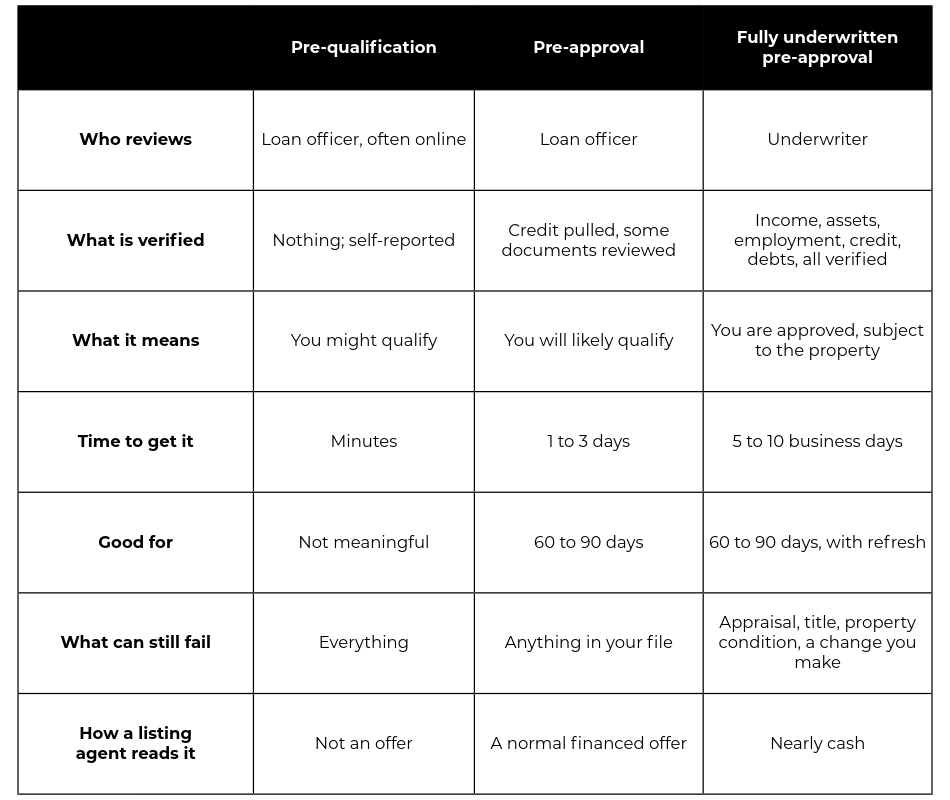
The middle column is where most buyers sit, and it is a weaker position than the letter suggests. A pre-approval can be withdrawn the moment the underwriter reads the file. The bonus income that does not count, the deposit that cannot be sourced, the student loan the credit report shows differently than the application: any of them ends it. Those discoveries are the reason financed deals stall in week three. An underwritten pre-approval moves them to week zero.
How does the underwriting process work before you have a house?
The same way it works after, minus the property. You give the lender everything, and the underwriter reads all of it.
Documents. Two years of W-2s or tax returns, 30 to 60 days of pay stubs, and two months of statements for every account you will use. Add a letter for any large deposit, your ID, and your authorization to pull credit. That is the documentation an underwriter needs to start. Self-employed buyers add two years of business returns and a year-to-date profit and loss statement.
Review. The underwriter's review calculates your qualifying income the way the loan program requires, which is often less than what you earn. Bonus and commission income need a two-year history. Rental income is discounted. Debt is pulled from the credit report, not your memory. The underwriter then issues a decision: approved, approved with conditions, or denied.
The approval. You receive a written approval that states the loan amount, the program, and the remaining conditions. For an underwritten pre-approval, those conditions are about the house: an acceptable appraisal, clear title, a signed purchase agreement, and homeowners insurance. Your lender can also give you a letter for the listing agent that says, in plain words, that underwriting is complete.
What you cannot do afterward. Change jobs, open credit, make a large unexplained deposit or withdrawal, or co-sign anything. The approval is a snapshot of a file, and the file has to look the same at closing.
Why does it matter in a Washington offer?
Because the Washington purchase contract gives a buyer several ways to look like cash. Every one of them is a gamble without an underwritten approval and a reasonable decision with one.
The financing contingency. Under NWMLS Form 22A, the financing contingency protects your earnest money if the loan is denied. A pre-approved buyer needs that protection, because the denial can still come from their own file. An underwritten buyer has already cleared the part of the loan that denials come from. That buyer can shorten the seller's right-to-terminate period in the addendum, or in a strong file waive the contingency, with the risk mostly limited to the appraisal.
The appraisal gap. Form 22AD lets a buyer commit to covering a low appraisal with extra cash. An underwritten buyer knows exactly how much cash the lender has verified and can size that commitment precisely. Our guide to appraisal gaps in Washington covers how to write it.
The closing date. A buyer who is already through underwriting can offer a 21-to-25-day close instead of 30 to 45. Our guide to how long closing takes in Washington shows which weeks disappear.
The phone call. When the listing agent calls your lender, an underwriter's approval changes the sentence. The lender says "this file is approved" instead of "this borrower looks strong." Sellers' agents have heard the second sentence from buyers whose loans later failed. They have not heard the first one from many. Our guide to how to buy in a seller's market puts this in the context of the full offer. Our checklist for competing with cash offers in Seattle shows where it sits among the other levers.
How long does it take, and how long is a mortgage pre-approval good for?
Five to ten business days to get, and 60 to 90 days of validity. Time it to the start of a serious search, not a casual one.
A standard pre-approval takes a day or two because nobody is verifying anything. An underwritten approval takes a week or two because an underwriter is reading a complete file. In a busy spring the underwriting queue itself can add days. Start the process when you are 30 days from writing offers.
Both kinds of approval expire, usually at 60 to 90 days, because the credit report and the pay stubs behind them go stale. Refreshing an underwritten approval is fast: a new credit pull and the latest pay stub and statements, reviewed against a file the underwriter already knows. Buyers who search for four months refresh once or twice. Buyers who switch lenders mid-search start over.
What can still go wrong after underwriting?
Four things, and three of them are about the house rather than you.
The appraisal comes in low. The approval was for a loan amount tied to a value. If the appraiser disagrees with the price, the lender funds against the lower number and you cover the difference, renegotiate, or walk under Form 22A's low-appraisal provisions.
Title has a problem. An unreleased lien or an easement that affects value can delay or block the loan until it clears. The preliminary title report in week two is where this gets caught.
The property type surprises the lender. A condo with a pending special assessment, a home with unpermitted work, or a property with a well and septic can trigger conditions the pre-house approval did not anticipate.
You change something. The one failure that is about you. A new car loan, a job change, a large withdrawal for the earnest money that was not documented. The approval assumed a file that no longer exists. Change nothing from application to recording.
What to know if you are buying
Get underwritten before you tour, be ready with every document, and treat the approval as the thing you are protecting for the next 45 days.
Ask for it by name. "Do you offer a fully underwritten pre-approval, where an underwriter reviews my complete file before I have a property?" If the lender hedges, call another one. Credit unions and local lenders often do this routinely; large online lenders often do not.
Hand over everything at once. The underwriter cannot approve a partial file. Two years of returns, two months of statements, every account, every pay stub, in one upload.
Use it to shorten the offer, not to waive everything. The approval lets you shorten the financing window and size an appraisal gap. It does not make waiving inspection safe; that is a separate decision our guide to waiving the inspection contingency covers.
Have the lender call the listing agent. A local lender who picks up the phone and says "underwriting is complete" does more for your offer than any letter. Our guide to how to choose a real estate agent in Washington includes how to pick a lender who will.
Protect the file. No new credit, no job changes, no undocumented money movement until the county records the deed.
What to know if you are selling
A fully underwritten buyer is the strongest financed offer you will see. Price its certainty when you compare it to cash.
Ask every financed buyer's lender one question. "Has this file been through underwriting?" The answer sorts your offers faster than the price does.
Read it with the contingencies. An underwritten buyer who also shortened the financing period and added an appraisal gap addendum has removed most of the ways a financed deal stalls. Our comparison of cash offers vs financed offers covers when that offer beats a lower cash one.
Keep the notice to perform in reserve. Even an underwritten buyer can hit an appraisal or title delay. Form 22AR still gets you a decision in 3 days if the date is at risk. Our guide to the notice to perform covers the timing.

Frequently asked questions
Is pre-approval the same as underwriting?
No. A pre-approval is a loan officer's assessment that you are likely to qualify. Underwriting is the formal review by the person with authority to approve the loan. A fully underwritten pre-approval is the second thing done before you have a house, which is why it carries weight a pre-approval does not.
How likely is it to get denied during underwriting?
For a buyer who was only pre-approved, denials and delays in underwriting are common enough that sellers' agents discount financed offers because of them. For a buyer who was fully underwritten before the offer, a later denial is rare. When it happens it almost always traces to a change the buyer made or a problem with the property, not to the original file.
Does every lender offer a fully underwritten pre-approval?
No. Many large lenders issue only standard pre-approvals before a property is under contract, because full underwriting costs them time on buyers who may never close. Local banks, credit unions, and mortgage brokers in competitive markets like the Puget Sound area more often do it, because their buyers lose without it. Ask directly.
Can I get fully underwritten with more than one lender?
You can, and some buyers do to compare pricing, but each lender needs the full document set and each pulls your credit. Multiple mortgage inquiries within a short window count as one for scoring purposes, so the credit effect is small. The time cost is real. Most buyers pick one lender for the underwritten approval and shop rates separately before locking.
Getting approved before you fall for a house
The buyers who win financed offers in Washington are not the ones who promise the most. They are the ones whose lender can say the loan is already approved. That sentence takes a week to earn, and it is worth more than almost anything else you can put in an offer.
At Every Door Real Estate, we help buyers get underwritten before the search starts and build offers that use it. We help sellers read financed offers for the approval behind the letter. If you are preparing to buy or weighing offers, talk with our team.
This article describes a general lending practice and how it interacts with NWMLS forms. Lender programs, underwriting standards, and approval validity periods vary. Confirm the specifics with your lender.
Check out this article next