Should you buy a house now or wait for rates to drop?
Buy when the monthly payment fits your budget with room to spare and you expect to stay five years or more. Wait when the finances are not ready, whatever the rate is doing. Rate timing on its own is a weak reason to do either.
The reason is that nobody can tell you where the rate will be in a year. Freddie Mac's weekly survey put the 30-year fixed rate at 6.71% in early September 2026 and 7.32% seven weeks later. A buyer who plans around a forecast is planning around a guess.
What you can know is your own payment. Lenders qualify you on the full payment at today's interest rate, so if that number fits, the purchase works at today's rate. If it does not fit, no rate forecast fixes it, and the right move is to improve the inputs you control: the down payment, the debt, the credit score, and the price range. Our guide to the average mortgage payment in Washington shows what that payment looks like city by city.
What does waiting actually cost in Washington?
Less than most buyers expect when the rate falls, and more than they expect when the price moves with it. The table runs the typical Washington home, $591,879 per Zillow's home value index as of September 2026, with 20% down and a $473,503 loan.
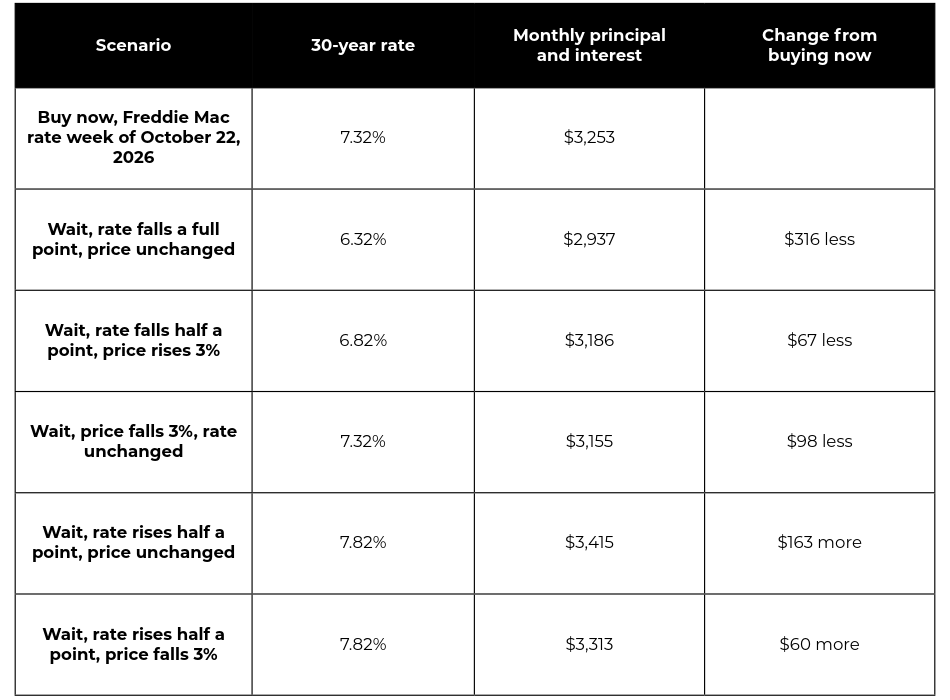
Three things stand out. A full point drop with no price movement is the best case, and it saves $316 a month. That is real money, and it is also the case that requires everything to go right.
The middle rows, where the rate moves a little and the price moves a little, change the payment by less than $100 either way. And a year of waiting is a year of rent paid on a lease that builds nothing, which the table does not count. Our comparison of renting vs buying in Seattle puts that cost next to the payment.
The price side matters more in Washington than the national guides suggest. Over the year to September 2026, Zillow shows Washington home prices soft: the statewide typical value down 0.3%, Seattle down 1.6%, and the Eastside cities down 3.9% to 5.2%. Home prices gave ground to hold the payment steady while the rate rose, which is how a housing market absorbs a higher rate. If rates fall, the buyers who stepped back come back, and the price relief goes with them. Our Seattle market page and Bellevue market page carry the figures.
How to buy a house with high interest rates: 5 ways to lower the rate or the payment
Five levers, in the order a Washington buyer should pull them. The first four lower the rate or the payment. The fifth lowers the price.
1. Ask for a seller-paid buydown or credit instead of a price cut
A seller credit applied to a temporary or permanent rate buydown lowers your payment more than the same dollars off the price. On the $473,503 loan, a 2-1 buydown drops the rate to 5.32% in year one and 6.32% in year two, which is $617 and $316 a month off the payment. It costs the seller about $11,196, and a price cut of the same size would save you about $60 a month.
The credit has to fit under the lender's cap. On a conventional loan that is 3% of the price with less than 10% down, 6% with 10% to 25% down, and 9% above 25%. FHA and USDA loans cap at 6%, VA at 4% for concessions. On the typical Washington home the 3% cap is $17,756, which covers a 2-1 buydown with room left. Our guide to seller credits in Washington covers the caps and what else a credit can pay for.
2. Buy the rate down permanently with points
Discount points are prepaid interest. One point costs 1% of the loan, $4,735 on the typical Washington purchase, and lenders commonly price it at roughly a quarter point off the rate, though the exact trade varies by lender and by week. At 7.07% instead of 7.32%, the payment drops about $80 a month for the life of the loan.
Points win over a 2-1 buydown when you expect to keep the loan a long time and rates to stay put. The 2-1 wins when your income is rising or you expect to refinance. The seller can pay for either one out of the same credit cap.
3. Get fully underwritten and shop the rate before you tour
Two lenders quoting the same day routinely differ by an eighth to a quarter point, and a credit score above 740 pulls the best conventional pricing. On the typical Washington loan a quarter point is about $80 a month for 30 years. Shopping the rate is the highest-return hour of the purchase.
Shop it from a position of strength. A fully underwritten pre-approval means an underwriter has already approved your file, subject only to the property. It lets you shorten the financing contingency and compete with cash, and it tells you the real payment before you fall for a house. Every Door Home Loans, the preferred lender for Every Door Real Estate, underwrites buyers before they offer and backs the offer with an earnest money guarantee. Ask them to quote the buydown and the points on your actual loan, not a range.
4. Buy now and refinance later, with the assumptions written down
"Marry the house, date the rate" is sound advice with two conditions attached. The first is that you can carry today's payment without the refinance. The second is that you understand what the refinance costs and what it assumes.
What it assumes is that rates fall enough to matter. On the typical Washington loan a full point drop saves $316 a month, or about $3,787 a year. A refinance has its own closing costs, which your lender will quote, and the savings have to cover them before the refinance pays off. A half-point drop may not get there.
Treat the refinance as a possibility that improves the deal, never as the thing that makes it affordable. Every Door Home Loans reviews existing loans for refinance when the rate moves, so the buyer who closes with them has someone watching for the window.
5. Target listings that have sat and negotiate the price
A listing past its second weekend has a seller who has watched the first wave of showings pass. That seller is the one who agrees to a credit, pays for the buydown, keeps the inspection repairs, and moves on price. In the Washington cities we track, days to pending have stretched, and that seller is a large share of the inventory.
The leverage runs the other way on the home that is priced right on day one. Our guide to how to buy in a seller's market covers that case, and our read on whether the Seattle area is a buyer's or seller's market covers how to tell which one you are in.
Should I sell my house now or wait?
Sell when the move itself is worth making and the next payment fits. The housing market does not have a better month waiting for you. Wait when the only reason to sell is a hope that rates fall and bring more buyers, because the same rate drop brings more sellers too.
Most Washington owners with a mortgage hold a rate well below today's, many of them locked before 2022. Selling means giving that rate up on the next purchase, and that is the real cost of moving in a high-rate market. It is also the reason inventory stays thin: every owner who stays put for the rate is a listing that does not exist, and that thin supply is what keeps prices from falling as far as the rate would otherwise push them.
For a seller, the question is not whether rates are high. It is whether the next home's payment, at today's rate, is one you want to carry. If it is, the buyer pool today is smaller but serious, and the thin inventory works in your favor. If it is not, the alternatives are a buy-before-you-sell structure, a bridge loan, or staying. Our guide to when is the best time to sell your home in Seattle covers the seasonal side of the same decision.
What is different about high rates in Washington State?
Four things, and each one changes a line in the contract or the budget.
The financing contingency has no rate cap. Under NWMLS Form 22A, the financing contingency protects your earnest money if the loan is denied. It does not protect you if the rate rises between offer and lock and the payment no longer fits. Lock early, and know the lock period covers the closing date.
Credits and buydowns have a place in the forms. A seller contribution toward loan costs goes in Form 22A's loan cost provisions at offer, or on Form 35R after inspection. The lender funds what it can see in the contract, not what was agreed over text.
A credit does not change the seller's excise tax. Washington's real estate excise tax is computed on the sale price and paid by the seller. A $15,000 credit leaves the price and the tax where they are, which is one reason sellers who refuse a price cut will often agree to a credit. Our cost to sell a house in Washington guide shows where the credit sits among the other costs.
No state income tax. A Washington household keeps more of the same salary than one in Oregon or California, and lenders qualify on gross income either way. That is part of why a $3,253 payment is carried here on an income that would strain across the border.
What to know if you are buying
Decide on the payment, then on the house, then on the rate.
Run the full payment at today's rate. Principal, interest, tax at about 0.9% of value a year, insurance, and PMI if under 20% down. The mortgage calculator gives the principal and interest; your lender gives the rest.
Get underwritten before you tour. It is the lever that makes the other four work.
Ask for the credit before you ask for the cut. The credit lowers your payment more, and sellers say yes to it more often.
Write the refinance plan down with its break-even. If the plan needs a full point to pay off, you are counting on a full point.
Use the programs. Washington's down payment assistance and first-time homebuyer programs reduce cash to close, and a few structures lower the payment.
What to know if you are selling
Your buyer's payment is what you are negotiating against, whether or not anyone says so.
Price to the last 90 days of closed sales. A buyer at 7.32% is running the payment on every listing. A price that pencils to a round monthly number draws offers; one priced to last spring draws a cut.
Offer a buydown instead of a cut. A $15,000 credit toward a buydown moves a buyer's payment more than $15,000 off the price, keeps your recorded sale price higher for the comparable sales on your street, and leaves your excise tax unchanged.
Read offers for the loan behind them. A fully underwritten buyer with a short financing window is often worth more than a higher offer from a pre-approved one. Our comparison of cash offers vs financed offers covers how to read the stack.
Plan your own purchase before you list. If you are buying next, get your own payment quoted at today's rate first. Our home selling checklist sequences the two.

Frequently asked questions
Should I lock my rate now or float it?
Lock when the payment at the locked rate fits and the lock period covers your closing date. Floating is a bet that rates fall before you close, and in Washington the financing contingency does not protect you if they rise instead. Ask the lender about a float-down option, which lets a locked rate follow the market down for a fee.
Why do people say it is not smart to buy a house right now?
Because the payment on the same house is higher than it was two years ago and prices have not fallen enough to offset it. That is true. It is also true for everyone else, which is why competition is lighter, sellers are paying credits, and listings sit long enough to negotiate. The buyer who can carry the payment is buying into lighter competition than in the years before rates rose.
How much income do I need to buy a house at today's rates in Washington?
About $139,400 a year for the statewide typical home with 20% down, using the 28% guideline on principal and interest alone. Add taxes and insurance and the real threshold is 10% to 15% higher. In Seattle the payment is $4,579 and in Bellevue $7,794, with the income thresholds to match.
Run your numbers before you decide
The decision is not whether rates are high. It is whether the payment on the home you want fits your budget at today's rate, with a plan for making it smaller that does not depend on a forecast.
At Every Door Real Estate, we help buyers get fully underwritten before they tour, size a buydown request, and write offers that use every lever above. We help sellers price to today's buyer and offer a credit before a cut. And through Every Door Home Loans, the same team quotes your actual payment, the buydown, the points, and later the refinance, on one file. If you are deciding whether this is your year, talk with our team and run the numbers first.
Payment figures are computed from the Freddie Mac average rate and Zillow's typical home values as of October 2026 and are estimates for comparison. Your rate, credit caps, and lock terms depend on your lender and loan program. Confirm the specifics before writing an offer.
Check out this article next