
Most people who buy a home already own one. That means two transactions, two closing dates, and one household that needs somewhere to live in between. The money from the first house is usually the down payment on the second, which is why the order and the timing matter so much.
The good news is that people do this every day, and there are only four ways to go about it. Some cost more and give you certainty, while others cost less and ask you to live with some open questions for a few weeks. This guide walks through all four and explains how each works under Washington's contract forms. It also helps you figure out which one fits your equity, your loan, and how fast your home is likely to sell.
How do you sell and buy a house at the same time?
You sell your current home first, buy the next one first, write an offer that depends on your home selling, or sell to a cash buyer who lets you set the date. Whichever you choose, you then use the contract terms, such as the closing date and a rent-back, to cover the gap between the two moves.
Here's how the four compare.
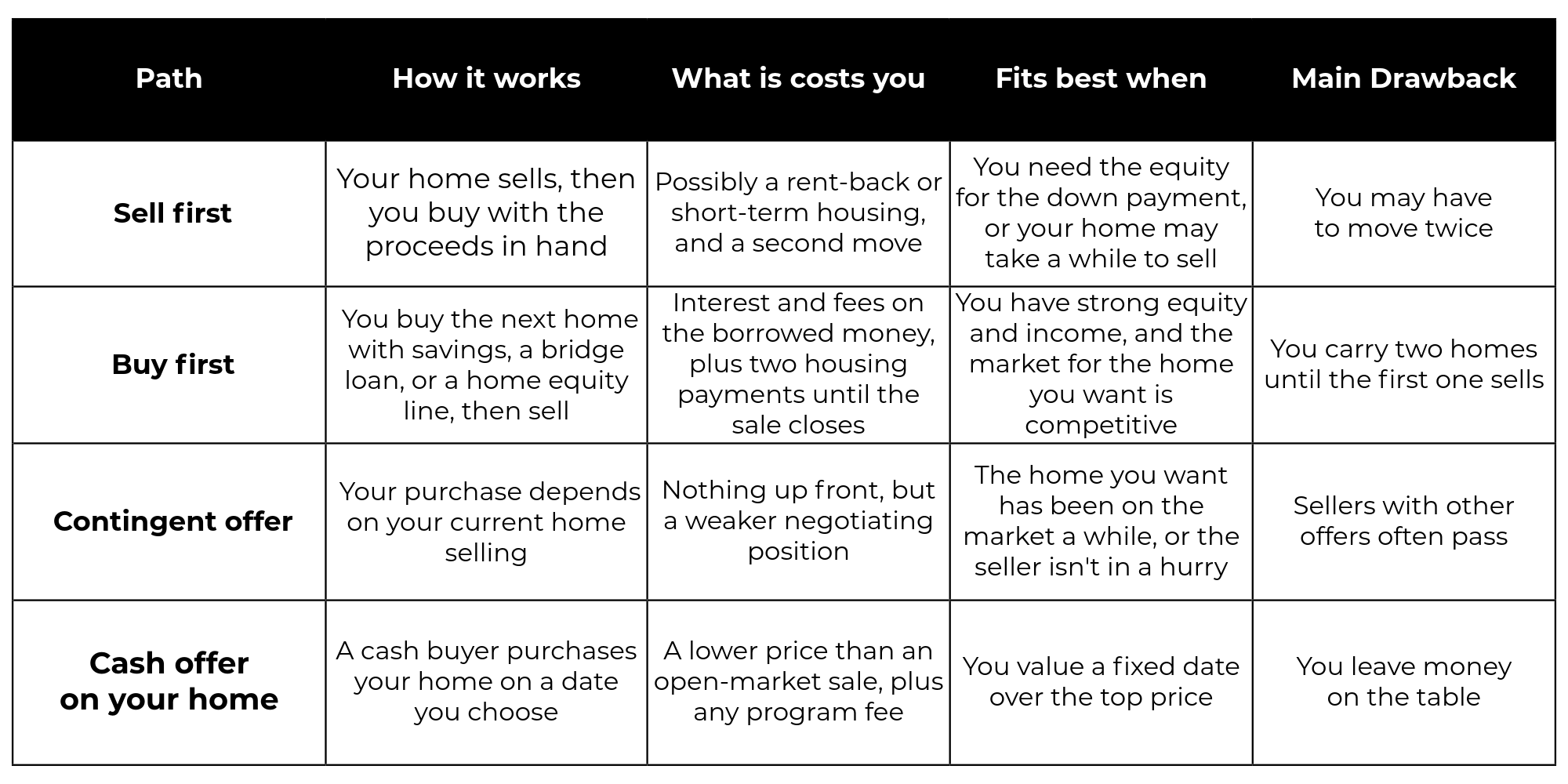
Should you sell first or buy first?
Sell first if you need the money from your current home to buy the next one, and buy first if you can afford to own both for a few months. Most people land somewhere in between, which is why the contingent offer and the rent-back exist. Which one fits comes down to your equity, your loan, and how quickly your home will sell.
How much equity do you have, and do you need it? If the down payment on the next home has to come out of this one, you can't close on the purchase until the sale closes, unless you borrow against that equity first. If you have savings to cover it, you have a lot more freedom in how you sequence things.
Can you qualify for the new loan while you still own the old one? A lender looks at your income against your debts, and if your existing mortgage is still on the books when you apply, it usually counts against you. Ask your lender early how they'll treat the home you're leaving, because the answer decides whether buying first is even on the table. Getting fully underwritten before you shop gives you the lender's actual answer.
How fast will your current home sell? This is the one the national guides can't answer, and it changes the math more than anything else. In Seattle, the typical home went pending in 18 days as of September 2026, according to Zillow's market data. The range by ZIP code is wide, though. Zillow's ZIP-level figures for the same month show homes in 98117, 98103, and 98115 in north Seattle going pending in 8 to 10 days, while 98107 in Ballard, where more of the sales are condos, took 30.
If your home is the kind that sells in a week or two, selling first carries little risk, and buying first means a short overlap. If it's in a slower segment, plan for a longer runway and lean toward selling first. Our read on whether Seattle is a buyer's or seller's market explains how to tell which situation a specific home is in, and you can start with what your home is worth today.
How to sell first without moving twice
Selling first is the safer order. You know exactly what you have to spend, and your offer on the next home isn't tied to anything. What you have to solve is the stretch between the day your sale closes and the day you can move into the new place. You can cover it with a rent-back, a later closing date, or temporary housing.
Rent-back agreements
A rent-back agreement lets you stay in your home after closing as the buyer's short-term tenant. You close and collect your proceeds, then keep living there while you close on the next house.
In Washington this is common enough to have its own form: NWMLS Form 65B, the seller occupancy after closing agreement. State law also sets the outer limit. Under RCW 59.18.040, a written rent-back stays outside the landlord-tenant act if two things are true. You stay no more than three months after closing, and you were represented by a broker or an attorney in the sale.
In practice most rent-backs are much shorter than that, because the buyer's lender expects them to move in soon after closing. A good rent-back agreement spells out the rent, the deposit, who carries insurance, and the condition the home has to be left in. In a market where sellers have several offers, a free or cheap rent-back is one of the things buyers offer to win.
A longer closing date
You can also ask your buyer for a later closing. Most financed offers close about a month to six weeks out, because that's how long the loan takes, but the date is negotiable like everything else in the contract. A longer closing gives you time to find and close on the next home before you have to hand over the keys. It works best when your buyer isn't in a hurry, and it costs you nothing.
Temporary housing
If the dates won't line up, the fallback is temporary housing: a short-term rental, a furnished apartment, or a stay with family. That means moving twice and paying for storage, which is the real cost of this path. It's also the lowest-pressure way to shop, because you're buying with cash in hand and no deadline.
How to buy before you sell
Buying first means you move once, on your own schedule, and you never have to show a home you're living in. In exchange, you own two homes for a while, and there are three ways to pay for that.
Bridge loans
A bridge loan is a short-term loan against your current home that covers the down payment on the next one. You pay it off when the sale closes. It lets you write an offer that doesn't depend on your home selling, which matters a lot when you're competing.
Bridge loans cost more than a regular mortgage. Expect a higher rate, origination fees, and a term of a year or less, and expect that not every lender offers them. Local banks and credit unions are the usual sources. Get quotes from two or three before you count on one.
Home equity lines of credit (HELOCs)
A home equity line of credit, or HELOC, lets you borrow against the home you own now to fund the down payment, usually at a lower cost than a bridge loan. You have to time it, though. Most lenders won't open a HELOC on a home that's already listed for sale, and approval can take several weeks, so apply well before the sign goes up.
Carrying two mortgages
If you have the savings for a down payment and the income to qualify for both loans, you can simply buy the new home and then sell the old one. It's the simplest path and the hardest to qualify for. Budget for more overlap than you expect, and keep a cash reserve for the months you're paying for both.
How does a home sale contingency work in Washington?
A home sale contingency makes your purchase depend on your current home selling. If it doesn't sell by the deadline in the contract, you can walk away and keep your earnest money.
In Washington, a home sale contingency is written on NWMLS Form 22B, and it works a little differently than the national guides describe.
First, the seller keeps marketing the home. If another buyer comes along, the seller can give you a "bump" notice. You then have a short window, set in the form, to waive the contingency and go forward, or to step aside. The form spells out what waiving requires, so read that part with your broker before you sign. A contingent offer holds your place, but it doesn't take the home off the market.
Second, the listing itself changes status. In the NWMLS, a home under contract with a buyer who still has to sell is shown as Contingent, which tells every other agent the home can still be bought. Our guide to contingent vs pending in Washington covers what each status means.
Once your own home is under contract, a different form applies and your offer gets much stronger. The seller is then waiting on a closing, which is far more certain than waiting on a buyer to appear. That's why the best version of this path is to list your home first, get it under contract, and then write the offer.
Can you close on both houses the same day?
Yes, you can, as long as the sale records first. It's also the plan where a few days of cushion is worth the most.
In Washington, closing happens when the deed records with the county, not when you sign. You sign both sets of documents a few days ahead. On closing day, your sale records first. Escrow then sends your proceeds to the escrow handling your purchase, and that deal records once the funds arrive. Using the same escrow company for both makes the handoff faster.
When it works, you hand over one set of keys and pick up the other the same afternoon. When a wire runs late or a loan document needs a correction, the second closing slides to the next day. So build in a buffer: close the sale a few days before the purchase, or pair a same-week closing with a short rent-back. Our guides to how long closing takes in Washington and when you get keys after closing cover the mechanics.
Cash offers and buy-before-you-sell programs
If a fixed date matters more to you than the last dollar, you can sell your current home to a cash buyer. You get an offer, you choose the closing date, and you shop for the next home knowing exactly when your money arrives. There are no showings and no financing risk on your sale.
You give up some price for that certainty. A cash buyer pays less than the open market would, and some programs add a service fee. Whether that's worth it depends on what the alternatives cost you: a bridge loan's interest, months of overlap, or a second move. Every Door makes cash offers on Seattle-area homes, and we'll show you that number next to what we think the home would bring on the market so you can compare them. Our guide to cash offers vs traditional loans explains how sellers weigh the two.
Some lenders and companies also run "buy before you sell" programs, which lend against your equity or make a backup offer on your home so you can buy first. They vary by state and change often. If you're considering one, confirm it operates in Washington and get the fee in writing.
What does it cost to sell and buy at the same time?
You pay the normal costs of a sale and the normal costs of a purchase, plus whatever it takes to bridge the gap between them.
On the sale. Washington's real estate excise tax is the line most sellers don't expect. The state rate is graduated, starting at 1.1% on the lowest price tier and stepping up from there, and your city or county adds a local portion on top. The Department of Revenue publishes the current tiers. Add broker compensation, title, and escrow. Our guides to the Washington excise tax and the cost to sell a house in Washington break it down.
On the purchase. Lender fees, title, escrow, and prepaid taxes and insurance. See our Washington closing costs guide.
On the overlap. This is the part your path decides. Selling first can mean rent, storage, and a second move. Buying first means two housing payments and interest on whatever you borrowed. A contingent offer costs nothing up front but may cost you in price. Get real quotes for your situation before you choose, because the cheapest path on paper isn't always the cheapest for you.
What to know on the selling side
Your sale sets the clock for everything else, so the goal is to make it predictable. Price the home against sales from the last 90 days. A home that sits throws off both timelines, so do the prep work before you list and go live ready. Our home selling checklist puts the steps in order, and our guide to the best time to sell in Seattle covers the seasonal side.
When offers come in, read the terms as closely as the price. A buyer who'll give you a rent-back or a flexible closing date may be worth more to you than one who offers a little more money and needs you out in three weeks.
What to know on the buying side
Be ready before you tour. That means a full underwriting review, a clear answer from your lender on how your current home is treated, and a plan for where the down payment comes from.
If you have to write a contingent offer, make it as strong as it can be. List your home first, so the seller can see it's priced right and on the market. Keep the contingency deadline short, and offer flexibility on the seller's closing date. It also helps to look hardest at homes that have been listed for a few weeks, where the seller has more reason to say yes.
Our guide to how long it takes to buy a house in Washington lays out the deadlines you'll be working against once you're under contract.
Lining up both moves with the Every Door Team
Most of the work in selling and buying together is getting two closing dates to cooperate, and that's easier when one team is watching both calendars. At Every Door Real Estate, the same broker can list your current home and represent you on the next one. Every Door Home Loans can tell you early whether you qualify to buy first. And if a fixed date matters most, we can put a cash offer next to a market estimate so you can choose.
If a move is on your horizon, talk with our team and we'll map out which path fits. You can also meet our agents or read our guide for homeowners moving up to a larger home.

Frequently asked questions
Is it hard to sell a house and buy at the same time?
It's manageable, and most of the effort goes into planning the order of things. Decide which path you're on before you start, and make sure your broker and your lender are talking to each other. It goes more smoothly if you settle the plan before you fall for a house.
Do you have to buy another house to avoid capital gains tax?
No. The federal exclusion doesn't depend on buying again. According to IRS Topic 701, you may be able to exclude up to $250,000 of gain on the sale of your main home, or up to $500,000 on a joint return. The main test is that you owned the home and lived in it for at least two of the five years before the sale. Talk to a tax professional about your own numbers.
Can one broker handle both my sale and my purchase?
Yes. One broker representing you on both transactions can set the two closing dates around each other and negotiate each contract with the other in mind. That's different from dual agency, which is when one broker represents both the buyer and the seller in the same sale.
What happens if my house sells and I haven't found the next one?
You use the tools from the sell-first section. Ask your buyer for a rent-back or a later closing while you keep looking, and have a short-term rental in mind as the fallback. It's also the strongest position to buy from, since your next offer has no sale contingency attached.
Market timing figures are from Zillow as of September 30, 2026. NWMLS form terms are defaults and can be changed in the contract. This guide is general information, not legal, tax, or lending advice.
Check out this article next